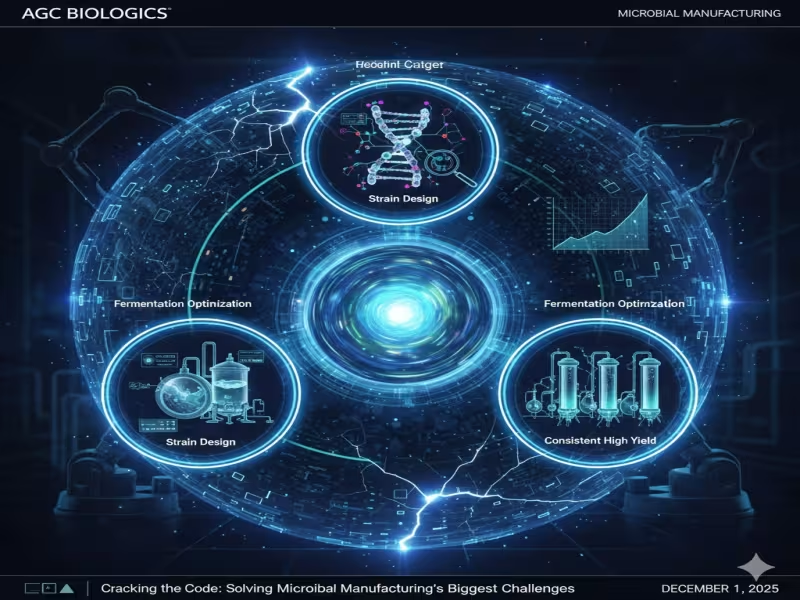
SHERIDAN, WYOMING - December 2, 2025 - Microbial fermentation is moving back to the center of biologics manufacturing strategy, and contract development and manufacturing organizations (CDMOs) like AGC Biologics are under pressure to turn the platform's greatest strength-speed-into a reproducible, industrial-scale advantage.
Microbial fermentation's resurgence - and its speed problem
Microbial systems have long been valued for fast, efficient production of biologics, and they are now seeing renewed interest for a new generation of therapies. Yet the same speed that makes microbial fermentation attractive also makes it unforgiving. Typical production runs last around 48 hours, leaving very little time to diagnose and correct process deviations once a run is underway.
Processes that appear stable at lab scale often behave differently in industrial settings, where vessel geometry, oxygen transfer and mixing dynamics change the biology. To keep timelines on track, sponsors and CDMOs must design microbial processes that are robust from the outset-able to deliver predictable yield and quality across many manufacturing campaigns, not just a handful of engineering batches.
Building expression systems for long-term manufacturability
Host cell selection and expression system design are foundational decisions that can determine success years later. High expression is important, but so is understanding the limits of a microbial strain and how it will behave under real-world manufacturing conditions. Choices that look attractive in early research can drive up product-related impurities or create downstream purification challenges.
Modern analytics allow development teams to compare host strains based on how they modify target proteins and how much product-related impurity they generate, helping to reduce downstream burden. At the same time, engineering a strain purely for higher theoretical yield can backfire: changes that boost expression on paper may alter cell physiology, increasing shear sensitivity or limiting oxygen transfer at larger scale and, ultimately, reducing overall productivity.
Getting fermentation right: oxygen, feeding and induction
Scaling microbial fermentation requires precise control of growth and expression phases. Oxygen transfer, nutrient delivery and induction strategy must be tuned as a single system to maintain product quality and consistency. Microbial cultures can demand up to 100 times the gas flow of mammalian systems, forcing process engineers to combine strategies such as:
- Increasing agitation
- Increasing the fraction of pure oxygen in the sparged gas
- Increasing gas flow rates
Each lever has consequences, especially for shear-sensitive strains. In parallel, nutrient feeding strategies must keep cells in a stable metabolic state across scales. Aggressive feeding can push metabolism toward cell growth at the expense of specific productivity and lead to accumulation of byproducts such as acetate, which undermines cell health, yield and stability. Under-feeding, by contrast, limits cell density and final output.
At high cell density, the induction phase becomes the pivot point where metabolism is shifted from growth to product expression. Feed rates are typically adjusted to create a carbon-source-limited environment that minimizes harmful byproducts, while temperature and induction duration are tuned to balance total yield and product quality.
Midstream design links upstream performance to downstream success
Once fermentation ends, midstream operations-cell separation, lysis and clarification-determine how efficiently product can be harvested from the biomass. Cell line and strain characteristics influence how easily cells lyse, what byproducts they release and how difficult it is to clarify the target molecule from cellular debris.
These considerations should feed back into early strain selection. A CDMO with deep microbial experience can flag cell lines that are likely to complicate lysis or clarification and help sponsors choose strains that better align with midstream and downstream capabilities. Decisions such as whether to lyse cells after paste collection in a protein-friendly buffer, or to lyse earlier to maximize yield despite higher impurity loads, require an integrated view of the entire process.
From academic precision to industrial repeatability
Drug developers often invest years in discovering molecules and optimizing therapeutic pathways, only to find that industrial-scale reproducibility is a different kind of challenge. Academic workflows are optimized for perfection in a single experiment; manufacturing must deliver consistent results across hundreds of runs, under tight timelines and regulatory scrutiny.
For sponsors pursuing microbial routes, partnering with a CDMO that understands both speed and robustness is increasingly critical. Organizations such as AGC Biologics, which emphasize rapid process transfer and adaptation, are positioning themselves to anticipate pitfalls, compress timelines and design microbial manufacturing platforms that can support commercial supply reliably.
For more information on microbial manufacturing partnerships and capabilities, readers can contact AGC Biologics directly through its corporate channels.