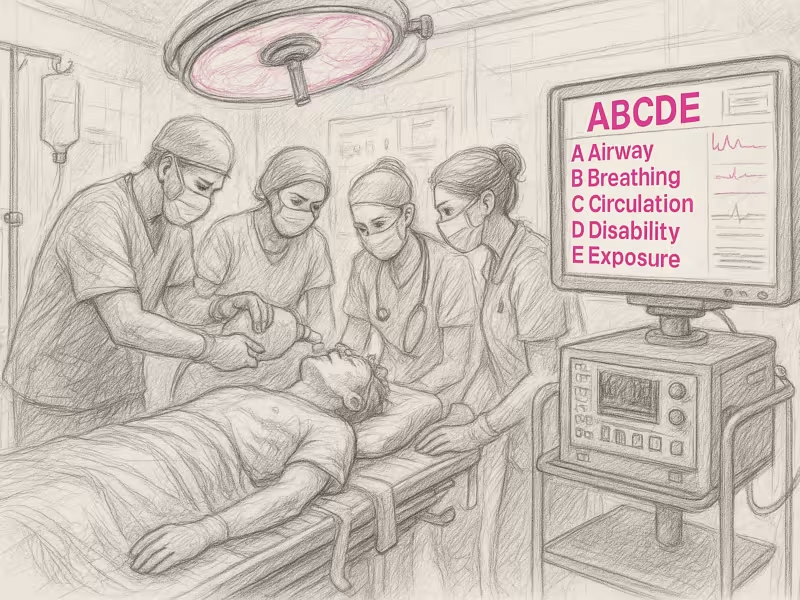
SHERIDAN, WYOMING - December 10, 2025 - A new collaboration between Deutsche Telekom, Fraunhofer IAIS and Kliniken der Stadt Köln is bringing AI agents directly into hospital trauma rooms, aiming to structure life-critical information in real time, ease documentation burdens, and ultimately improve outcomes for severely injured patients.
From Chaotic Trauma Room to Structured, Real-Time Overview
In a typical trauma room, up to ten physicians and nurses work under extreme time pressure while all medically relevant information is exchanged verbally. The partners are developing an AI-powered real-time display system that "listens" to team conversations during trauma simulations at Cologne's Merheim Hospital.
The AI agent continuously extracts and categorizes findings, interventions and decisions according to medical priorities and presents them in a structured graphical interface. At the same time, the data is recorded as a basis for treatment documentation and quality assurance. The goal is to support trauma teams with an always-up-to-date situational overview, reduce cognitive load and minimize avoidable errors in the most critical minutes of care.
Aligning AI Logic with the ABCDE Protocol
Clinically, the system is anchored in the ABCDE protocol-Airways, Breathing, Circulation, Disability and Exposure-which guides the prioritization of life-threatening conditions in modern trauma care. The AI agent is designed to recognize when team members mention relevant observations, such as a "coarse bubbling sound" in breathing or anticoagulant medication use, and map them to the correct ABCDE category.
The application presents a live status display in a traffic-light format aligned with the protocol, highlighting gaps and changes as they occur. Beyond the acute phase, the same data stream flows automatically into standardized documentation forms, supporting hospital quality programs and reducing manual paperwork for clinicians.
Secure Cloud-Edge Architecture for Sensitive Health Data
A core design principle is sovereignty and resilience of data processing. The solution can run in the "cloud-edge continuum": either fully on-premises on dedicated hospital servers-without any internet connection-or via the Open Telekom Cloud as part of Deutsche Telekom's AI Foundation Services. In both cases, data is stored exclusively within Europe under European data protection standards.
The one-year prototype project, launched in September, relies on a modular toolkit for AI solutions, an edge agent framework, lightweight models and automated workflows for data processing and training. It is part of the EU's IPCEI-CIS program, which aims to establish a multi-provider, sovereign cloud-edge continuum for Europe. The architecture is explicitly intended as a blueprint for other AI-agent solutions in highly regulated environments beyond healthcare.
Clinical Partners Stress Reliability and Practical Usability
Fraunhofer IAIS leads the AI architecture and multi-agent framework design. "With the development of a versatile multi-agent framework and its adaptation to the demanding requirements of emergency medicine, we are laying the foundation for relieving medical teams during the treatment of critically injured patients," said department head Stefan Rüping, highlighting trusted speech processing, robust data management and edge capabilities as key components.
Kliniken der Stadt Köln brings emergency and intensive care expertise and runs realistic trauma simulations at its supra-regional trauma center in Merheim, where around 600 trauma patients are treated annually. "By integrating medical expertise and realistic trauma room simulations, we are bridging the gap between research and practice," noted emergency physician Jerome Defosse, MD. Advisory partners include the Bundeswehr Hospital in Berlin and the Florence Nightingale Hospital in Düsseldorf, who emphasise resilience, offline capability and ease of use in clinical workflows. A fully operational offline prototype is targeted for summer 2026.
Model for Sovereign AI in Critical Infrastructures
For Deutsche Telekom and T-Systems, the trauma room project showcases how sovereign AI infrastructure can deliver tangible benefits in critical public services. "AI is already saving lives today. Our AI agent for emergency medicine serves as a model for other industries as well. With this practical solution, we demonstrate the value of sovereign digital infrastructure for both the economy and the greater good," said Ferri Abolhassan, Member of Deutsche Telekom's Board of Management and CEO of T-Systems.
If successful, the approach could be extended from trauma rooms to other high-intensity clinical environments such as stroke units, cardiac cath labs or emergency departments-providing hospital CIOs and CMOs with a reusable architecture for safely deploying AI agents at the bedside and at the edge.
To explore the partners' AI initiatives and healthcare collaborations in more detail, please visit their official corporate websites.