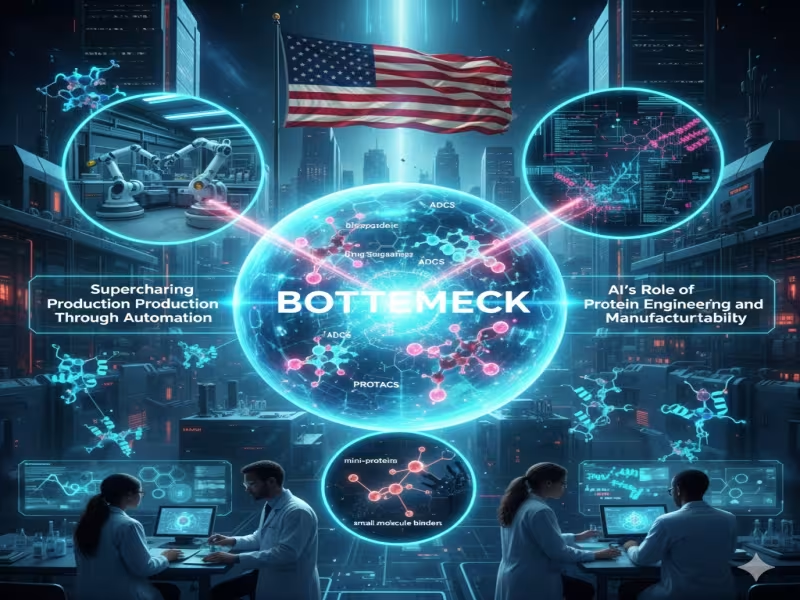
SHERIDAN, WYOMING - December 2, 2025 - As bispecifics, antibody-drug conjugates (ADCs), protein degraders and AI-designed mini-proteins move rapidly into clinical development, discovery teams are confronting a new bottleneck: not target ideas, but the practical engineering and scalable production of molecules that strain conventional biologics workflows.
From monoclonals to a radically more complex biologics toolbox
Monoclonal antibodies still anchor the biologics market, with more than 160 FDA approvals and a dominant share of global drug revenues. But the modality mix is shifting fast. More than 200 ADCs are now in clinical stages, bispecific approvals have climbed to 19 with sales above $12 billion in 2024, and regulators are increasingly supportive of novel protein formats.
This surge of structural diversity is changing where risk sits in development. For many R&D organizations, the challenge is no longer whether a target is druggable, but whether highly engineered constructs can be produced, purified and scaled reliably enough to justify moving them into the clinic. As a result, discovery groups are leaning on partners such as Viva Biotech to integrate protein engineering, structure-function insights and manufacturability thinking from the outset.
Heterogeneity and mispairing: the new pain points in complex biologics
Next-generation biologics bring an inherent risk of heterogeneity. "The biggest problem with these biologics is really the heterogeneity in actually generating these molecules," said Paul Wan, vice president of early discovery and business development at Viva Biotech. "You're getting mispaired chains in bispecifics or trispecifics and also different conjugation variants when you're looking at ADCs."
To address these issues, platform-level engineering has emerged as a core strategy. Technologies such as controlled Fab-arm exchange, knobs-into-holes and crossMab architectures, combined with site-specific mutations, help enforce correct chain pairing and reduce misassembled species. In the ADC arena, more precise conjugation chemistries and non-natural amino acids give teams tighter control over drug-to-antibody ratios, which have historically been a source of clinical delay and variability.
Automation and parallel purification supercharge construct throughput
On the execution side, high-throughput and automation are increasingly critical. Parallel multistep purification enables simultaneous expression and screening of hundreds of constructs, with inline QC confirming quality in near real time. Industry analyses for the first half of 2025 indicate that labs adopting advanced automation and parallel purification have achieved three- to five-fold increases in construct turnover and a notable rise in novel formats entering early development.
For structural biology, the ability to iterate rapidly across formats is particularly valuable. As Jerry Zhang, director of biology at Viva Biotech, noted, "High-throughput protein production can allow us to try different variations, and potentially it can help us to find the best construct that we are looking for that we can use for protein production or some structural biology or even some assays." Some organizations now routinely express thousands of constructs in fully automated workflows, including bispecifics and tetraspecifics that would have been impractical a decade ago.
AI weaves sequence, structure and manufacturability together
AI has moved from the periphery of protein science to the center of the engineering cycle. Model architectures have evolved from traditional machine learning to deep and graph neural networks, and now to transformer and diffusion-based large language models for proteins. "But nowadays, since we have protein large language models, they provide much richer approaches to better describe these proteins. And on top of that is the recent advance of the AlphaFold-like structure prediction tools," said Yue Qian, executive director of computational chemistry and AI platform at Viva Biotech.
These advances support predictions of stability, solubility and even expression yields based on sequence and structure, helping teams flag aggregation or glycosylation liabilities before committing to scale-up. Viva Biotech's three-part AIDD platform-V-Scepter for complex protein parameterization, V-Orb for physics-based binding and stability modeling, and V-Mantle for generative construct design-aims to align in silico proposals with early manufacturability, backed by in-house experimental data that include both successful and failed constructs.
Degraders, molecular glues and mini-proteins stress-test platforms
Protein degraders, molecular glues and AI-designed mini-proteins push integration even further by combining chemistry and protein engineering in a single modality. PROTAC development demands "linkology" expertise and direct-to-biology screening to evaluate large linker libraries without purification, while FRET-based proximity biosensors and CRISPR-enabled cellular assays are needed to validate ternary complexes in live cells.
Molecular glues raise the bar again, as they induce novel protein-protein interactions rather than simply binding an existing pocket, making discovery hit rates lower and screening more dependent on sophisticated techniques such as DNA-encoded libraries and affinity selection mass spectrometry. At the same time, de novo mini-proteins designed by AI challenge both expression platforms and structural biology, requiring cryo-EM, crystallography and expression optimization to converge.
Data quality and cross-platform learning remain the next frontier
Despite rapid progress, consistent prediction of expression and manufacturability across systems remains elusive. Differing cell platforms, buffer conditions and assay setups make it difficult to assemble uniform datasets. "Protein production and protein engineering are huge tasks, and each data point takes significant effort to generate," said Qian. "The challenge is consistency. Different expression systems or experimental conditions can make data hard to compare directly."
To close that gap, organizations are investing in proprietary datasets that better reflect biological reality, integrating negative as well as positive results into AI models and aligning AI design closely with structure-based drug design. For biopharma R&D leaders, the message is clear: building the next generation of biologics will require not only new modalities, but also tightly integrated partnerships that fuse protein engineering, automation, structural biology and AI into one manufacturability-aware discovery pipeline.
For more information on how Viva Biotech partners with discovery teams on complex biologics and AI-enabled protein engineering, interested stakeholders can reach out via the company's official corporate channels.