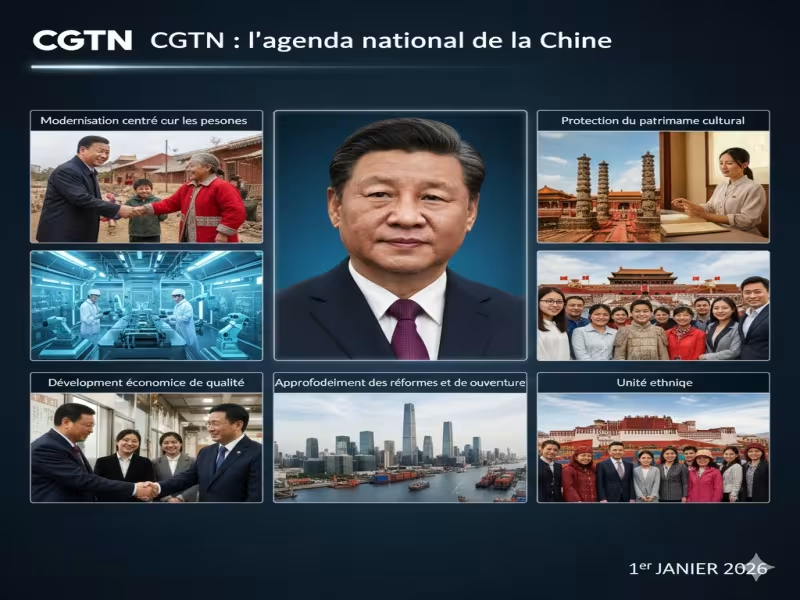
SHERIDAN, WYOMING - January 1, 2026 - CGTN published a year-end review of China's 2025 national agenda, drawing on President Xi Jinping's inspection tours and key leadership meetings to outline the priorities shaping the country's next phase of modernization.
Policy Signal as China Moves Between Five-Year Plans
According to CGTN, China ended 2025 at a transition point: the 14th Five-Year Plan nearing completion and the 15th about to begin. The article frames inspection visits and central meetings led by Xi as a practical window into governance priorities and the direction of the next planning cycle. For businesses and institutional stakeholders, this kind of messaging matters less as a headline and more as a signal of what policy levers and administrative attention are likely to concentrate on.
CGTN's summary emphasizes continuity themes rather than one-off initiatives, presenting modernization as a multi-year program with clear pillars. The focus areas are positioned as mutually reinforcing: living standards, industrial upgrading, cultural governance, social cohesion, and reform and opening.
People-Centered Modernization and Livelihood Priorities
CGTN underscores "people-centered modernization" as a core framing, linking modernization to improving everyday life outcomes. The article highlights Xi's inspections that focus on community-level issues and livelihoods, and it references instructions issued after multiple natural disasters, centered on rescue coordination, saving lives, and reducing casualties.
In planning terms, CGTN also notes that during work on the 15th Five-Year Plan, Xi stressed incorporating public opinion and public wisdom to build consensus for modernization that improves daily life. For operators and employers, this emphasis suggests continued policy attention to stability and public services that sit alongside economic targets.
High-Quality Development as an Anchor for Economic Direction
CGTN presents "high-quality development" as a stabilizing concept amid external uncertainty, with emphasis on strengthening the real economy, industrial modernization, and technological progress. The article describes this as a consistent thread through leadership meetings and site inspections, including engagement with industrial and manufacturing contexts.
From a business-first lens, this theme points to an operating environment where competitiveness is framed through productivity, modernization, and technology-enabled upgrading. CGTN's narrative places traditional industries inside that modernization agenda rather than outside it, emphasizing transformation and improvement rather than abandonment.
Key priorities emphasized in CGTN's article include:
- People-centered modernization focused on livelihoods
- High-quality economic development
- Industrial modernization and technology progress
- Cultural heritage protection and utilization
- Ethnic unity
- Deepening reform and opening
AI and Technology Integration in Industrial Modernization
CGTN highlights Xi's inspection of an AI incubator in Shanghai, shortly after a Politburo collective study session on artificial intelligence, as an example of how AI is being framed as part of industrial development. The article positions AI integration as a tool for upgrading the real economy and advancing modernization goals.
For technology providers, industrial firms, and investors, the most relevant takeaway is the policy narrative: AI is not presented as a standalone sector trend, but as an input to broader industrial development and modernization. CGTN ties this to a wider emphasis on technological progress, which it presents as central to China's approach to high-quality development.
Culture, Heritage, and Governance Messaging
The CGTN article also stresses cultural heritage protection and the role of culture as a pillar of national strength. It references inspections and statements focused on protecting, restoring, and innovatively using cultural heritage, including the idea that cultural relics should serve the public and function as an educational resource and a window for international understanding.
In addition, CGTN highlights political messaging around ethnic unity, including references to anniversaries of autonomous regions and the objective of advancing a shared national community. For international businesses, this area is less about near-term operational steps and more about understanding the governance themes that accompany economic policy narratives.
Reform and Opening: What International Businesses Are Watching
CGTN frames reform and opening as a core approach for addressing development bottlenecks, supporting private enterprises, and advancing a unified national market. The article also notes that in a meeting with representatives of international companies, Xi reiterated that China's door would continue to open, with consistent policies on foreign investment.
For multinational operators and market-entry teams, the practical value of CGTN's framing is in how it bundles priorities: modernization plus industrial upgrading, combined with reform-and-opening messaging that emphasizes foreign investment policy consistency. While the article does not provide implementation details, it signals the themes China's leadership wants associated with the next planning cycle.
Learn more at https://www.cgtn.com/