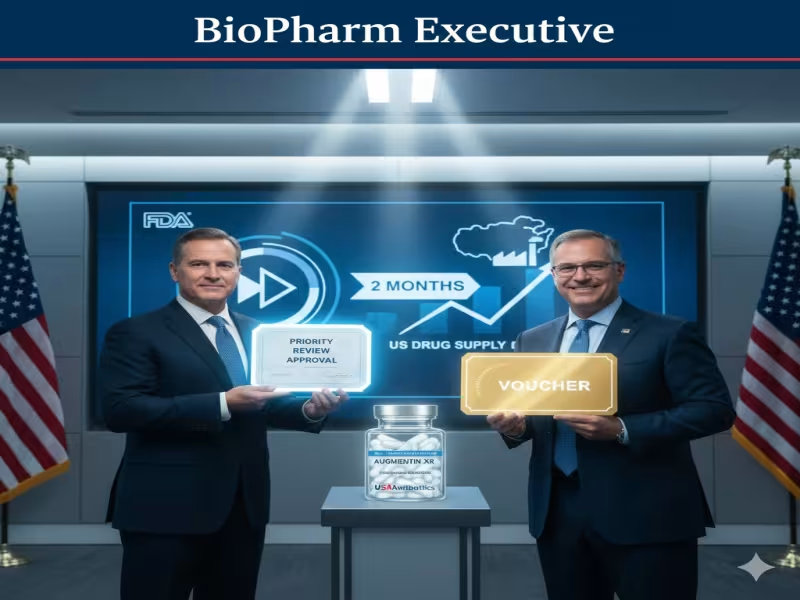
SHERIDAN, WYOMING - December 11, 2025 - The FDA's first use of its new Commissioner's National Priority Voucher (CNPV) has gone not to a cutting-edge biologic, but to a decades-old extended-release antibiotic, Augmentin XR-sending a clear signal that domestic manufacturing and supply resilience are now front-and-center regulatory priorities for the U.S. pharmaceutical industry.
A New Fast-Track Tool Aimed at Supply Chain Security
Launched in June, the CNPV program promises to compress review timelines from the usual 10-12 months to as little as 1-2 months for drugs that align with U.S. "national priorities," such as strengthening domestic production or addressing systemic shortages. The first approval under this framework went to USAntibiotics' Augmentin XR after the FDA completed its review in "just two months," focusing heavily on quality, manufacturing and facility assessments rather than new clinical data.
Public communication to date has not fully clarified what new regulatory status this "approval" confers on the long-established product, originally developed by GSK and first cleared in 2002. What is clear is the rationale: Augmentin XR's domestic manufacture is being framed as a way to reinforce the U.S. antibiotic supply chain at a time when availability of basic anti-infectives has become a recurring pain point for hospitals and payers.
Why a Legacy Oral Antibiotic Became a National Priority
Augmentin XR combines amoxicillin with the β-lactamase inhibitor clavulanate in an extended-release formulation, long used against common bacterial infections. Today, USAntibiotics is the sole domestic manufacturer-an increasingly important fact as policymakers view generic oral antibiotics as critical national infrastructure, not just commodity products.
"Domestic pharmaceutical manufacturing capacity is a national security imperative, not a luxury," USAntibiotics president Patrick Cashman said following the announcement. That framing aligns with broader federal concern over dependence on overseas manufacturing for active pharmaceutical ingredients, intermediates and finished dosage forms in essential medicines.
For generic manufacturers, the message is that investments in U.S. facilities, redundancy and quality systems may now be rewarded not only through public contracts but also via materially faster regulatory timelines that reduce time-to-market and capital at risk.
Integrated Quality Assessment as a Differentiator
According to the FDA, the CNPV process enabled "integrated quality assessment and enhanced communication" between agency experts and the sponsor, covering drug substance, drug product, facilities and biopharmaceutics within a tightly coordinated review. That contrasts with more traditional, sequential assessments that can create gaps in feedback and last-minute surprises late in the cycle.
For industry quality leaders, this first CNPV approval illustrates how closer, earlier dialogue on manufacturing science, process robustness and facility readiness can de-risk reviews, particularly where supply continuity is a primary objective. As more vouchers are deployed, sponsors will be watching closely to see whether this integrated assessment model becomes a new benchmark for high-priority products beyond antibiotics.
Implications for Portfolio and Site Strategy
The first two CNPV batches have already included advanced gene therapies, diabetes and obesity treatments alongside an essential oral antibiotic, reflecting the program's broad remit. For pharmaceutical manufacturers, the Augmentin XR case underscores several strategic implications:
- Legacy assets can become strategic if they sit at the intersection of public-health need and domestic manufacturing capability.
- Site location and redundancy decisions may increasingly factor into regulatory-relationship management, not just cost and tax considerations.
- Quality and supply-chain investments that historically competed with short-term margin targets may now support faster approvals and stronger policy alignment.
As regulators and industry refine how CNPV criteria are applied, companies with significant U.S. manufacturing footprints-particularly in anti-infectives and other essential medicines-will be well placed to position their products as future candidates.
Navigating a More Politicized, Priority-Driven FDA Landscape
For regulatory affairs and corporate strategy teams, the broader takeaway is that U.S. drug review is becoming more explicitly priority-driven, with new tools that can reward alignment with national industrial and health-security goals. At the same time, questions remain about transparency, predictability and how CNPV decisions will interact with existing expedited pathways.
In that context, the Augmentin XR decision functions as an early case study of how manufacturing-centric value propositions can translate into tangible regulatory benefits, even for mature small-molecule products. Companies that can articulate similar stories-linking domestic capacity, quality, and supply resilience to public-health outcomes-are likely to shape the next wave of CNPV awards.