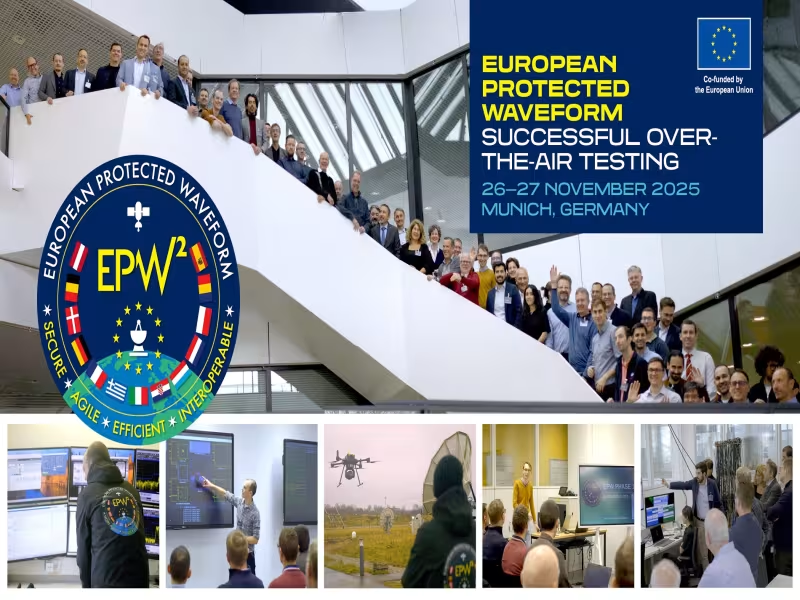
SHERIDAN, WYOMING - December 10, 2025 - Europe has taken a decisive step toward defence communications sovereignty with the successful over-the-air demonstration of the European Protected Waveform (EPW), validating a new generation of secure, resilient, multi-orbit military satellite communications across GEO and LEO.
Milestone trial proves resilience against jamming and cyber threats
Conducted on November 26-27, 2025 at Universität der Bundeswehr München in Germany, the EPW tests confirmed the waveform's ability to protect mission-critical links against jamming, cyber threats and unauthorised access. For defence ministries facing increasingly contested and congested spectrum, the results provide concrete evidence that next-generation protected satcom can be engineered on European soil and operated across both geostationary and non-geostationary constellations.
Belgian National Armaments Director Major General Filip Borremans underlined the strategic dimension of the milestone, stating: "The successful EPW demonstrations perfectly illustrate the mission of the European Defence Fund, enabling Member States to achieve collectively what none could accomplish alone. By uniting 19 partners from 13 nations, the consortium has demonstrated that European collaboration delivers both technical excellence and strategic autonomy. Secure satellite communications are a cornerstone of modern defence, and EPW proves that through coordinated European investment, we can develop sovereign solutions that strengthen our collective security."
A collaborative blueprint for European strategic autonomy
EPW is co-funded by the European Union through the European Defence Fund and led by Belgium's Ministry of Defence, with ST Engineering iDirect Europe as consortium lead. The programme brings together 19 industrial and academic partners from 13 nations to tackle the toughest challenges in modern military satcom: rapidly evolving cyber and electronic threats, demand for higher throughputs, and the need to support highly mobile, dispersed operations.
By focusing on standards-based design and interoperability from the outset, EPW is intended to serve both national and coalition use cases, allowing European forces to interconnect across platforms and orbits while maintaining sovereign control over critical technologies. The over-the-air tests mark the transition from design and lab validation to real-world performance proof, a prerequisite for future procurement and deployment decisions.
From lab to field: paving the way to full capability
The successful campaign in Munich clears the programme to move into full prototyping and system-level testing. "The EPW consortium's successful completion of this major milestone, demonstrated live and witnessed by supporting military end-users, represents a critical step toward the next phase of the EPW programme," said Koen Willems, Vice President, EU Programmes, at ST Engineering iDirect Europe. "This achievement paves the way for the prototyping and testing of the final capability, which will deliver secure and resilient communications for Europe. It underscores the consortium's unwavering commitment to advancing Europe's strategic autonomy in military communications through innovation and collaboration."
In practical terms, the next phase will focus on refining waveform performance across diverse operational scenarios, integrating EPW into multi-orbit network architectures and validating how the technology behaves under realistic mobility and interference conditions. For defence planners, this work is directly linked to long-term decisions on protected satcom architectures, procurement frameworks and interoperability with allied systems.
Multi-orbit protected satcom as an operational game-changer
For European armed forces, a standards-based protected waveform that works seamlessly across GEO and NGSO satellites promises several operational advantages. It can enable resilient connectivity for command and control, ISR, and joint operations even in heavily contested environments, while offering flexibility to route traffic across different constellations based on mission, threat and capacity.
At the same time, EPW's emphasis on efficiency and security can help ministries of defence achieve better utilisation of space segment resources and ground infrastructure. In an era of constrained budgets and rising threat complexity, the ability to share a common protected standard across services and nations-without compromising sovereignty-directly supports long-term capability planning.
Towards a future-proof European protected waveform standard
With a total programme value of €29.9 million (including up to €25 million from the EU), EPW is designed as a 39-month effort to define secure waveform standards for future-proof satcom. The ambition is not just to deliver a technical demonstrator, but to create a robust foundation for future acquisition programmes and industrial ecosystems around secure, interoperable European satcom solutions.
As the consortium advances toward full prototyping and field testing, EPW is emerging as a flagship example of how coordinated EU investment, industrial collaboration and defence-user engagement can translate strategic autonomy into concrete capabilities on the ground-and in orbit.
For more information on ST Engineering iDirect Europe and its role in European defence satcom programmes, visit https://www.idirect.net/st-engineering-idirect-europe/.