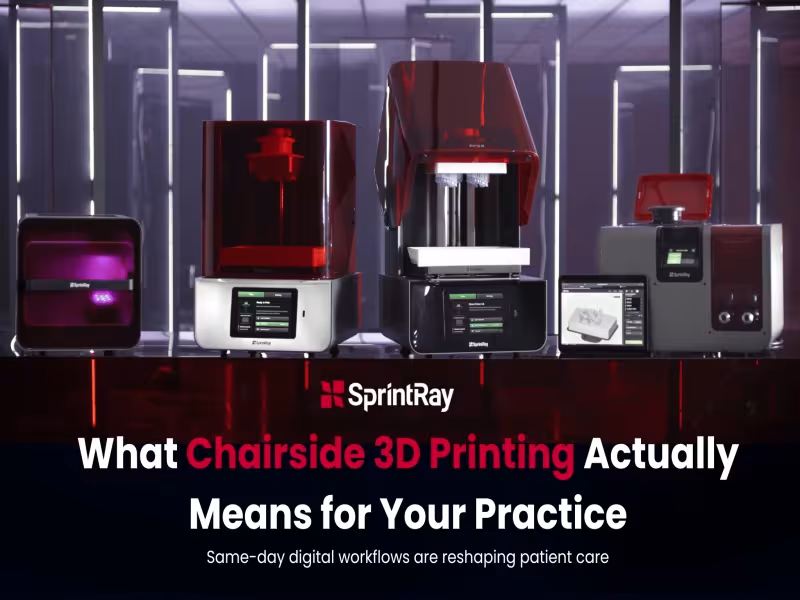
SHERIDAN, WYOMING - December 8, 2025 - Chairside 3D printing has moved from conference buzzword to everyday reality in U.S. dental practices, and SprintRay is positioning its ecosystem as a way for clinics to bring production in-house, compress treatment timelines, and turn same-day crowns into a strategic differentiator rather than a marketing slogan.
From Lab Dependency to In-Practice Production
At its core, "chairside" simply means producing the restoration in your own practice while the patient is still in your care, instead of sending cases to an external lab and waiting one to two weeks. Clinically, the workflow is familiar-examination, preparation, design and cementation remain the same-but the fabrication step moves from a third party you can't control to equipment in your operatory that you can.
The traditional model looks like this: impression, lab shipment, a long wait, and a second visit. With chairside 3D printing, the sequence becomes: digital scan, in-office print, 30-90 minutes of processing, and delivery of the definitive restoration in a single day or next-morning slot. As the article notes, "Chairside 3D printing isn't coming. It's here. And it's not a gimmick-it's the modern standard for how modern practices deliver restorative care."
Why 3D Printing, Not Just Milling, Matters Now
Same-day dentistry was pioneered with chairside milling, where ceramic or composite blocks are milled in 10-20 minutes by high-cost systems. Chairside 3D printing takes a different, more versatile path: building restorations layer by layer from light-cured, biocompatible resins and ceramic-filled composites.
Compared with traditional chairside milling, the 3D printing value proposition is:
- Lower capital investment: around $20,000-22,000 for a complete system.
- Broader indications: beyond crowns to surgical guides, night guards, dentures, aligners and models.
- Complex geometries: better support for intricate designs and multi-unit runs.
For practices, that means the same chairside platform can support multiple revenue streams and clinical services, with economics that are accessible for solo practitioners and small groups-not just large multi-site operators.
Patient Experience: From Two-Week Temporary to One-Touch Resolution
From the patient's perspective, the change is stark. Under the lab model, a single crown can mean two injections, two appointments, two copays and two weeks of living with a fragile temporary that may debond at the worst possible moment.
Chairside 3D printing compresses this into:
- A single extended appointment where the tooth is prepared, digitally scanned and the definitive restoration is produced.
- A short waiting window in which patients can relax in the lounge, run a local errand or return later the same day.
- An optional next-morning placement model that still avoids long waits and temporary discomfort.
This not only removes a major source of anxiety and inconvenience, it also changes the psychology of treatment acceptance. When a practice can say "we can do this today" instead of "come back in two weeks," more patients say yes, sooner.
Operational and Financial Upside for the Practice
For practice owners and managers, chairside 3D printing reshapes both operations and cash flow. Key shifts include:
- Timeline control: No lab backlogs, holiday delays or rush surcharges. Emergency Friday cases can be completed the same day.
- Quality control: If a printed crown doesn't seat perfectly, the design can be adjusted and reprinted immediately instead of sending it back and asking patients to wait yet again.
- Revenue timing: Moving from a 6-10 week cycle (prep → lab → delivery → payment) to roughly 4-8 weeks, improving cash flow.
- Scheduling efficiency: One visit instead of two reduces no-show risk, frees chair time and simplifies booking.
Many practices also discover a premium pricing opportunity: patients are often willing to pay 15-25% more for a same-day crown because they avoid an additional visit, a temporary crown and a second interruption to their work or family schedule.
Competitive Positioning in a Fast-Moving U.S. Market
Market expectations are evolving quickly. Patients accustomed to same-day delivery in other parts of their lives increasingly expect fewer visits and faster outcomes from dental care. At the same time, roughly 15% of U.S. practices already have at least one 3D printer, meaning that "same-day crowns" is rapidly moving from a differentiator to a baseline expectation in many local markets.
As the article emphasizes, "The practices thriving in 2025 and beyond are the ones adapting to where dentistry is going, not clinging to where it's been. SprintRay is here to be your dedicated partner with a complete ecosystem that delivers reliable, cutting-edge results." For clinics evaluating their next investment cycle, the question is less whether chairside 3D printing will become standard, and more whether they want to benefit from the early-adopter phase while it still confers a clear competitive edge.
Chairside 3D printing with SprintRay Pro 2 gives practices direct control over timeline, quality and patient experience, while improving economics and positioning the clinic as a technology-forward provider in an increasingly demanding U.S. dental market.
For more information on chairside 3D printing workflows and the SprintRay ecosystem, visit https://sprintray.com/.