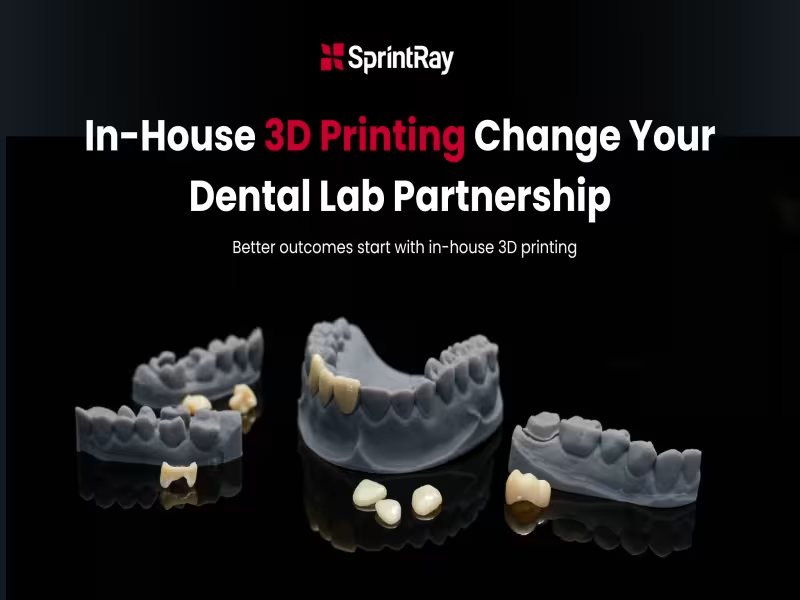
SHERIDAN, WYOMING - December 8, 2025 - As more practices adopt chairside 3D printing, many clinicians worry quietly about what it means for long-standing dental lab relationships-but rather than replacing labs, in-house production is reshaping them into higher-value, more strategic partnerships built around clearly defined roles and shared digital workflows.
From Full Lab Dependency to Hybrid Production
For years, the dominant model in restorative and appliance production has been full lab dependency: every crown, bridge, model, surgical guide, night guard or retainer went out the door to a third-party provider. In that setup, "Lab controls your timeline. Lab controls your cost per case. Lab capacity limits your capacity. Emergency cases wait on lab availability."
With in-house 3D printing, routine work can be produced inside the practice while complex, highly aesthetic or technique-sensitive cases continue to flow to the lab. The result is a hybrid model in which simple crowns, bridges, models, guides and emergency cases are handled chairside, while multi-unit, multi-shade and specialty material work remains firmly in the lab's domain.
What Really Changes in Day-to-Day Collaboration
Clinically, workflows do not disappear; they are redistributed. Practices that adopt chairside printing typically bring into the operatory:
- Simple single-unit crowns and short-span bridges
- Surgical guides and treatment-planning models
- Night guards, retainers and immediate/emergency cases
At the same time, labs retain and often grow their role in:
- Complex and multi-unit restorative cases with demanding esthetics
- Cases requiring difficult shade matching or layered ceramics
- Specialty materials and advanced techniques beyond chairside scope
The key insight from SprintRay's perspective is that "Your lab relationship evolves from dependency to strategic partnership." In-house 3D printing adds production capacity for routine work, while the lab becomes a specialist partner focused on cases where its craftsmanship and material expertise have the most impact.
Aligning the Economics for Practices and Labs
Economically, bringing routine production in-house changes the mix rather than eliminating lab spend. For practices, chairside printing offers:
- Lower cost per unit on many everyday appliances and restorations
- Faster turnaround times, often same-day or next-morning
- Emergency capacity that is no longer constrained by lab schedules
- Reduced dependency on external capacity for predictable, routine work
For labs, the model shifts toward:
- Higher margins on complex, specialist work
- Less low-margin commodity production and more craftsmanship
- Stronger relationships with practices that value expertise and consultation
- Focus on advanced cases, materials and digital design services
Lab invoices may shrink on a per-practice basis, but the work that remains is better aligned with where labs create the most value.
How to Transition Without Damaging Lab Relationships
SprintRay's guidance emphasizes that success depends on communication and a phased rollout rather than a sudden switch. A practical roadmap looks like this:
- Step 1: Have the conversation - Tell your lab you are bringing 3D printing in-house, outline what you plan to produce yourself, and ask for their input.
- Step 2: Start small - Begin with models and surgical guides that do not disrupt the lab's core restorative business.
- Step 3: Cherry-pick carefully - Move simple, low-risk cases in-house while continuing to send complex work to the lab, demonstrating that high-value case volume is stable.
- Step 4: Redefine the relationship - Position the lab as your specialist partner, not a commodity vendor, and stop sending work that neither party profits from.
- Step 5: Communicate openly - Maintain an ongoing dialogue about case selection, indications and shared digital workflows.
Most practices find a sustainable hybrid balance over six to twelve months, building confidence with in-house printing while preserving and even strengthening their lab partnerships.
How Labs Are Responding to the Shift
The lab industry is actively adapting to the rise of chairside 3D printing. Rather than fighting the trend, many are pivoting towards:
- Higher-complexity cases that require master technicians
- Deeper integration with digital workflows and data exchange
- Advisory roles on material choice, case design and esthetic planning
- Faster turnaround on premium work that justifies higher fees
In this model, labs move up the value chain, offering expertise and advanced services rather than competing on volume for routine, price-sensitive work that practices are increasingly equipped to produce themselves. The future, as the article stresses, is not all in-house or all lab, but "the strategic use of both, with practices controlling routine work and partnering with labs on cases where specialized expertise creates value."
Strategic Advantage Through a Combined SprintRay and Lab Workflow
For practices evaluating in-house 3D printing, the question is not whether they will "cut out" their labs, but how they can use technology to reshape the division of labor. SprintRay positions its ecosystem as the infrastructure for that transition: a way to take control of everyday production while building more balanced, long-term partnerships with labs that focus on complex restorative cases.
Strategic lab partnerships combined with in-house 3D printing create optimal workflows-practices control routine production while collaborating with labs on complex cases requiring specialized expertise.
For more information on building a hybrid in-house and lab-based digital workflow with SprintRay, visit https://sprintray.com/.