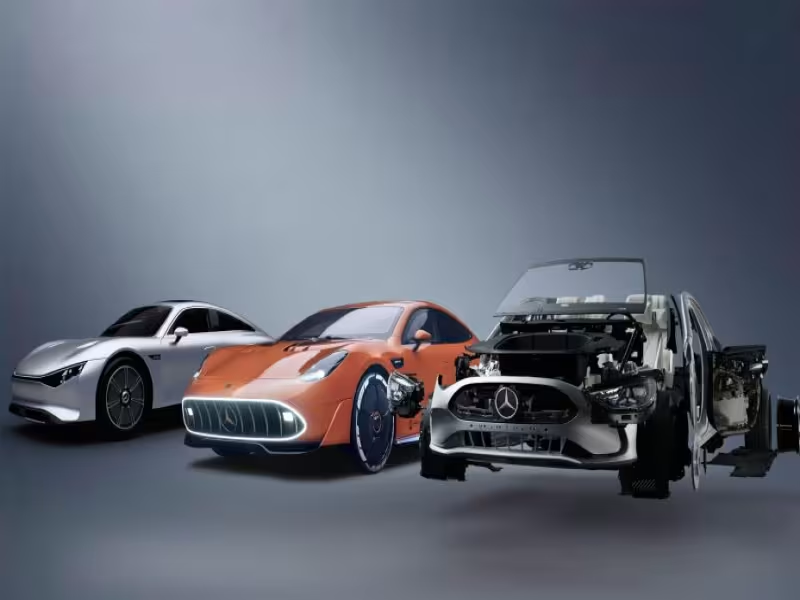
SHERIDAN, WYOMING - December 11, 2025 - Mercedes-Benz is expanding its sustainability playbook with "Tomorrow XX", a cross-portfolio technology program designed to decarbonize vehicle components, scale circular materials and turn end-of-life cars into a strategic raw-materials source. For OEMs, suppliers and material innovators, the initiative signals how one of the world's leading premium automotive brands plans to industrialize low-carbon, circular design across its global lineup.
Holistic sustainability roadmap across the Mercedes-Benz portfolio
Tomorrow XX extends the holistic, multi-disciplinary approach first showcased in the VISION EQXX and CONCEPT AMG GT XX to the entire product portfolio, across all drivetrains. From the earliest design stages through to end-of-life, every component and material is being scrutinized for CO₂ impact, resource intensity and recyclability.
"There can be no doubt that the overriding goal for all our products is to excite our customers while decarbonizing the automobile, driving down resource use and growing the circular economy. Innovation is a key route to achieving this and Tomorrow XX makes clear the huge strides we are taking. Together with our suppliers and partners, we are leading the way and embedding sustainability deep into our operational business and along the entire supply chain," said Olaf Schick, Member of the Board of Management Mercedes-Benz Group AG, Integrity, Governance & Sustainability.
The program already encompasses more than 40 new component and material concepts that either are in series production, close to launch or at an advanced R&D stage - all developed to Mercedes-Benz quality, design and comfort standards.
Rethinking components for disassembly, repair and recycling
A core pillar of Tomorrow XX is "Design for Environment" and "Design for Circularity": components are engineered from the start so they can be dismantled, repaired and recycled efficiently.
One flagship example is a re-engineered headlight concept. Instead of glue, its lens, trim, housing and electronics are joined with mechanical fasteners. That makes it possible to replace only the damaged lens after a stone chip, extending service life, saving cost and avoiding waste. Because each module is designed as a mono-material, the share of secondary material can be almost doubled versus today's headlamps while cutting CO₂ emissions by up to half.
Interior door panels are also being redesigned with a new thermoplastic rivet that can be undone, simplifying repair and enabling clean separation of different materials at end-of-life. This kind of join-technology innovation is critical for scaling true circularity in complex interior systems.
Scaling mono-materials, recycled plastics and low-carbon metals
With around 550 pounds of plastic in a modern Mercedes-Benz vehicle, Tomorrow XX puts strong emphasis on mono-material solutions and high-quality recyclates. One highlight is a PET "mono-sandwich" structure for interior parts such as door pockets. Built entirely from recycled PET, it cuts component weight by more than 40% compared with primary plastic, while maintaining performance. The concept has already won the Materialica "CO2 Efficiency" Award and is moving into series production.
The brand is also ramping up pre- and post-consumer recyclates for components such as washer fluid reservoirs and bumpers, and exploring carpet and floor mats with up to 75% lower carbon footprint through 100% PET content.
On the metals side, Mercedes-Benz is working with partners to decarbonize aluminum and steel across the value chain. Initiatives include:
- Aluminum for the new CLA produced in electrolysis plants powered by renewable energy, reducing around 400 kg CO₂ per vehicle.
- Low-carbon aluminum from partner Hydro with 70% fewer emissions than the European average and targets to cut this by ~90% by 2030.
- Pilot aluminum side walls with up to 86% post-consumer scrap content, while maintaining surface quality.
- Steel products with 100% scrap content via electric-arc furnaces and R&D into virtually zero-carbon steels based on hydrogen-DRI and higher scrap ratios.
Urban mining, tires, airbags and batteries: harvesting new material streams
Tomorrow XX also frames today's vehicles as tomorrow's mines. A pilot "urban mining" project with TSR Group in north-west Germany focuses on optimizing collection and processing of end-of-life vehicles to reintegrate post-consumer materials into new Mercedes-Benz models.
Several material streams are being re-imagined:
- Scrap tires converted via chemical recycling into pyrolysis oil, then mass-balance plastics for high-quality components such as flush door handles, leather alternatives and acoustic insulation.
- Recycled airbags (fiberglass-reinforced polyamide) used in high-stress parts like engine mounts and thermal valve housings.
- Underbody cladding made from mixed plastics recovered from shredder residue, reducing CO₂ footprint by up to 40%.
- Brake pads with around 40% recycled content from scrap pads paired with CO₂-reduced steel back plates, cutting emissions by up to 85%.
In the battery value chain, Mercedes-Benz is targeting more than 70% CO₂ reduction at cell level through green electricity in cell production, dry-coating technologies, high-recycled cathode/anode materials and a pilot recycling plant in Kuppenheim. New battery systems on the MMA platform already follow Design for Circularity principles, avoiding composite components and non-separable joins to improve recyclability.
From innovation showcase to industrial standard
"Mercedes-Benz has always been an innovation powerhouse. With our 'Design for Environment' and 'Design for Circularity' approaches, we are rethinking literally every single component from scratch. The Tomorrow XX technology program pushes this holistically across our entire product portfolio and value chain to the limits of what is possible. More than 40 new and more sustainable component and material concepts in just two years is a phenomenal result and a taste of the enormous potential we are unlocking," said Jörg Burzer, Member of the Board of Management of Mercedes-Benz Group AG, Chief Technology Officer, Development & Procurement.
Alongside material science and circular design, the program connects directly to manufacturing: nearly 100% of production waste is already recycled, steel scrap loops are closed, and aluminum scrap is next. BIONICAST® lightweight castings, expanded polypropylene underbody panels and bio-based plastic concepts for door modules further reduce both emissions and material costs.
For suppliers, recyclers, chemical companies and technology partners, Tomorrow XX sends a clear message: Mercedes-Benz expects scalable, traceable and circular solutions that can meet stringent automotive standards - and is ready to industrialize them as part of its long-term sustainability and competitiveness agenda.