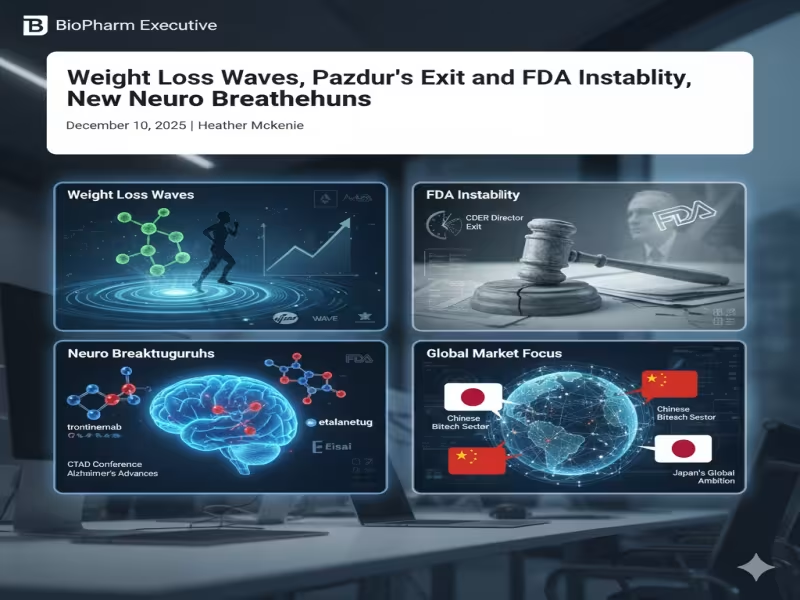
SHERIDAN, WYOMING - December 11, 2025 - A new convergence of obesity dealmaking, regulatory uncertainty at the U.S. Food and Drug Administration (FDA) and fresh neurology data out of the Clinical Trials on Alzheimer's Disease (CTAD) conference is forcing biopharma executives to recalibrate their 2026 playbooks across R&D, partnering and risk management.
Obesity Dealflow Enters a More Competitive, High-Stakes Phase
Pfizer continues to double down on cardiometabolic disease, following its $10 billion acquisition of obesity startup Metsera with an exclusive collaboration to license YaoPharma's oral GLP-1 receptor agonist YP05002. Together with other emerging oral and peptide GLP-1s, this next wave of assets is pushing obesity beyond a single-product, single-modality market and into a diversified, highly competitive landscape.
At the same time, Wave Life Sciences and Structure Therapeutics have injected fresh volatility with early and mid-stage obesity data that analysts describe as "very disruptive" and "highly competitive." For incumbents, this raises the bar on differentiation in terms of safety, durability of weight loss and cardiometabolic benefit, while for smaller biotechs it increases both the potential upside of breakthrough data and the execution risk around trial design, endpoints and commercialization.
FDA Leadership Churn Amplifies Regulatory and Policy Risk
The retirement of Richard Pazdur just three weeks into his tenure as director of the FDA's Center for Drug Evaluation and Research (CDER) is the latest signal of instability at the agency's senior levels. Pazdur's departure leaves FDA with only a small handful of veteran leaders compared with one year ago, adding uncertainty around how accelerated approval, real-world evidence and rare-disease flexibility will be interpreted case-by-case.
For sponsors, this leadership churn translates into practical execution risk: review teams may take more conservative positions on borderline datasets; advisory committee dynamics could shift; and programs relying on novel endpoints or surrogate markers may require more extensive justification. On the public-health side, the CDC's vaccines advisory committee has already shown its willingness to revisit long-standing norms by recommending deferral of hepatitis B vaccination from birth to two months of age for some infants, underlining that prevention strategies are also in flux.
CTAD Spotlights Next-Generation Alzheimer's and Neurodegeneration Assets
Neurology pipelines took center stage at CTAD, where Roche's trontinemab emerged as a standout. The antibody, designed to improve blood-brain barrier penetration, lowered amyloid below the threshold of positivity in 92% of treated patients in a mid-stage study, reinforcing the direction of travel towards earlier intervention and deeper amyloid clearance. If replicated in larger, longer trials, this could accelerate payer discussions around value, durability and real-world cognitive benefit.
Eisai, meanwhile, is working to reverse the sector's poor track record in anti-tau development. New data on etalanetug showed reductions across all measurable forms of MTBR-tau243, a biomarker closely tied to tau tangle pathology in Alzheimer's disease. While biomarker wins are not yet clinical wins, the results validate tau as an increasingly actionable axis in disease-modifying strategies and may encourage renewed investment into combination approaches targeting both amyloid and tau.
Strategic Takeaways: From China's Biotech Engine to Japan's Global Ambitions
Beyond individual assets, this week's executive-level analysis highlights two structural trends that will shape partnership and portfolio decisions. First, large pharmas are reassessing how they work with the Chinese biotech sector, moving from opportunistic in-licensing towards more structured, multi-asset alliances that balance innovation access with geopolitical and supply-chain risk.
Second, Japan's pharmaceutical industry is stepping more assertively onto the global stage, building on strengths in complex modalities and long-term therapeutic focus. For Western biopharma, this raises both partnership opportunities and competitive pressure in indications like neurology, oncology and rare diseases, where Japanese companies are sharpening their late-stage and commercialization capabilities.
What Senior Biopharma Leaders Should Watch in 2026
Taken together, the latest obesity deals, FDA leadership changes and CTAD readouts point to a 2026 environment where clinical differentiation, regulatory narrative and global partnership strategy will matter as much as headline efficacy. In obesity and Alzheimer's disease in particular, sponsors will need to prove not only that their agents work, but that they can sustain benefit, navigate evolving regulatory expectations and secure compelling real-world positioning against a rapidly growing field of competitors.
For boardrooms and R&D leaders, the message is clear: obesity and neurology are becoming even more attractive but more crowded, while U.S. regulatory uncertainty increases the premium on early, data-driven engagement with FDA and on diversified global development pathways.
For a deeper strategic breakdown of these obesity, regulatory and neurology shifts, follow the full discussion via the publisher's podcast channels and executive briefings.