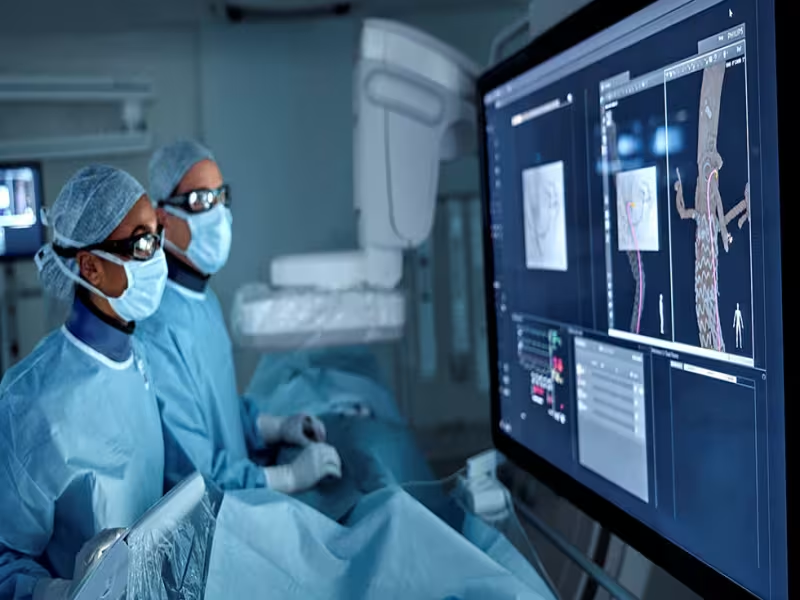
SHERIDAN, WYOMING - December 2, 2025 - Royal Philips is expanding commercial availability of its LumiGuide 3D Device Guidance solution across Europe and the United States, positioning its real-time, AI-enabled, light-based navigation technology as a new benchmark for radiation-free image-guided therapy in complex endovascular procedures.
Real-time 3D navigation without continuous X-ray
LumiGuide is billed as the world's first real-time AI-enabled light-based 3D navigation solution for image-guided therapy, and its wider rollout was spotlighted at RSNA 2025. Instead of relying on continuous X-ray, the system allows clinicians to visualize and guide devices inside the body using light, offering a radiation-free* navigation path for endovascular teams. The move from limited to full commercial availability is a core milestone in Philips' long-term strategy to improve radiation safety and dose reduction in minimally invasive interventions.
Powered by Philips Fiber Optic RealShape (FORS) technology, LumiGuide uses an optical fiber integrated into guidewires to reflect light and reconstruct the shape and position of devices in real time. The result is high-resolution, full-color 3D images from any angle, giving operators instant orientation during challenging procedures such as fenestrated and branched aortic repairs.
Clinician experience highlights efficiency and dose reduction
Early adopters report significant gains in workflow and safety. "I have done over 160 fenestrated and branched aortic procedures with LumiGuide and have found that the system improves efficiency, reduces the procedure time, and reduces time on the fluoroscopy pedal to near zero," said Adam W. Beck, MD, Professor and Director, Division of Vascular Surgery & Endovascular Therapy, University of Alabama at Birmingham, US.
By combining FORS-based visualization with AI algorithms that rapidly align images to patient anatomy, LumiGuide aims to help teams navigate with precision while sharply reducing radiation exposure to both patients and staff. In complex aortic repair procedures, Philips cites cases performed 37% faster with up to 56% dose-area product (DAP) reduction [1], directly supporting hospital goals around throughput, safety and staff retention in high-volume labs.
Deep integration with the Azurion image-guided therapy platform
A key differentiator for Philips is LumiGuide's seamless integration with Azurion, the company's flagship image-guided therapy platform. Designed to drive procedural innovation across clinical domains, Azurion treats more than 6.4 million patients per year in over 80 countries [2], making it a strategic foundation for new tools that combine imaging, navigation and therapy.
LumiGuide joins a growing suite of intelligent, AI-enabled supportive and therapeutic devices on Azurion, including guidance technologies and tools such as DeviceGuide and VeriSight 3D ICE. "Moving LumiGuide from limited to full commercial availability is an important milestone in expanding access to advanced image-guided therapy," said Stacey Beske, Business Leader Image-Guided Therapy Devices at Philips. "By bringing this light-based navigation technology to more hospitals, we're helping clinicians treat complex vascular disease with precision and safety, while reducing radiation risk for patients and teams in the lab," added Atul Gupta, MD, Chief Medical Officer Diagnosis & Treatment at Philips.
Accelerating adoption in Europe and the United States
Following a limited market release in late 2023, LumiGuide will become commercially available from January 2026 in key European markets and the United States. The solution has already been used in more than 2,000 clinical procedures [2] in combination with Azurion, providing Philips and its customers with real-world data on how light-based navigation performs in day-to-day practice.
Philips is continuing to invest in evidence generation and clinical programs to help hospitals and vascular centers optimize LumiGuide usage, from complex aortic repairs to other advanced endovascular interventions. For providers, the expanded rollout offers a clear pathway to de-risking radiation exposure while modernizing navigation capabilities across integrated cath, hybrid and vascular OR environments.
Building a low- and no-dose interventional strategy
LumiGuide also extends Philips' broader portfolio of technologies focused on radiation safety and dose management in image-guided therapy. Alongside Azurion with ClarityIQ, DoseAware, EchoNavigator and clinical initiatives such as the RADIQAL trial, the company is positioning itself as a leader in low- and no-dose interventional solutions. At RSNA, Philips also unveiled BlueSeal Horizon, a new 3.0T MRI platform featuring the world's first helium-free 3.0T magnet and next-generation AI to enhance diagnostic workflow and precision-further evidence of its focus on sustainability and intelligent systems across the care continuum.
For vascular programs, radiology departments and hospital executives, LumiGuide's expanded availability offers a concrete opportunity to pair advanced procedural navigation with a long-term strategy for radiation reduction, lab efficiency and staff safety within a single, connected Azurion ecosystem.
For full technical details and integration options for LumiGuide within Philips' Image Guided Therapy portfolio, visit https://www.philips.com/lumiguide.