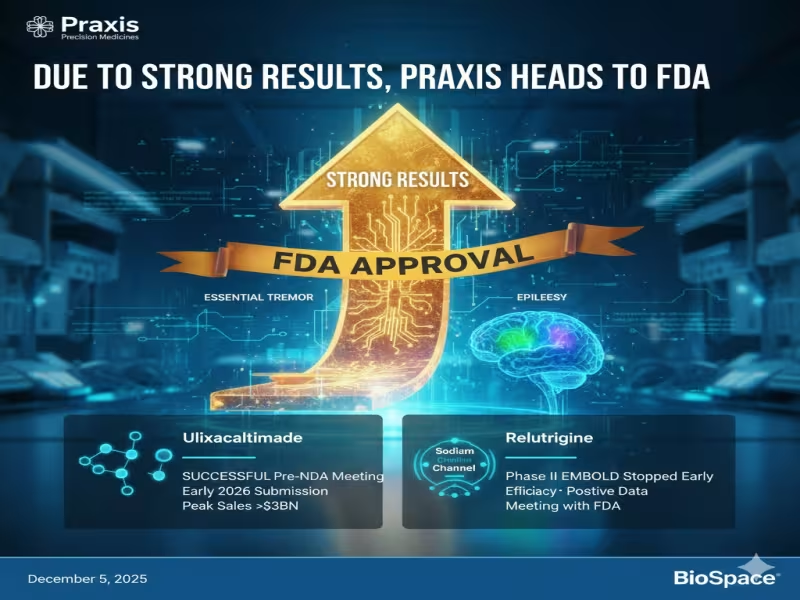
SHERIDAN, WYOMING - December 8, 2025 - Praxis Precision Medicines has doubled down on its neurology strategy with back-to-back updates: a Phase II win for its sodium current blocker relutrigine in rare developmental and epileptic encephalopathies (DEE) and a "successful" pre-NDA meeting for its essential tremor candidate ulixacaltamide, positioning the Boston biotech as a potential new commercial player in both ultra-rare epilepsy and movement disorders.
Relutrigine Study Stopped Early for Efficacy in DEE
Praxis has halted its mid-stage EMBOLD trial of relutrigine early, after an independent data monitoring board recommended the study "stop the study early for efficacy." The Phase II EMBOLD study is evaluating relutrigine in patients with DEE linked to SCN8A and SCN2A mutations, a small but highly underserved genetic epilepsy population with limited therapeutic options and high unmet medical need.
Relutrigine is an oral, small-molecule sodium current blocker designed to precisely modulate sodium channels by inhibiting persistent currents, which Praxis identifies as a major driver of symptoms in severe DEE. Previous cohorts have shown that relutrigine is well-tolerated, induces biomarker changes consistent with sodium channel modulation and leads to "robust" improvements in motor seizures, supporting the decision to advance development. Detailed EMBOLD data will be presented on December 6 at the American Epilepsy Society (AES) conference, after which Praxis will meet the FDA to align on next clinical and regulatory steps.
Analysts See Upside in Peak Sales and Label Expansion
The early stop for efficacy immediately shifted market expectations. In a Thursday note, Truist Securities wrote that relutrigine could hit peak U.S. sales of approximately $650 million by 2037. The bank added that this forecast could still be "conservative," "given likely broader utilization or relutrigine in other types of DEE, once relutrigine is approved for SCN2A/8A." For a precision epilepsy therapy in a genetically defined population, those figures imply not only attractive pricing but also meaningful headroom for label expansion if the mechanism translates across additional DEE subtypes.
For payers and specialty centers, a well-tolerated oral agent with strong seizure control in SCN8A/SCN2A-linked DEE could shift treatment algorithms away from off-label polypharmacy, while giving Praxis a clear foothold in high-acuity pediatric neurology.
Ulixacaltamide Pre-NDA Meeting De-Risks Essential Tremor Pathway
On the same day, Praxis announced it had completed a pre-NDA meeting with the FDA for ulixacaltamide, its investigational calcium channel inhibitor for essential tremor (ET). According to the company, it has now aligned with the agency on the content of a New Drug Application and expects to submit in early 2026.
While the press statement offered few clinical details, Jefferies analysts read the outcome as a strong regulatory signal. "We remain 70%+ confident in approval," they told investors, adding that ulixacaltamide could hit "$2.5B+ peak sales," while noting that this projection could still be "conservative." Truist was similarly bullish, projecting that ulixacaltamide could reach "> $3BN" in U.S. peak sales by around 2040 and arguing that Thursday's dual update "further de-risks both ET and DEE programs."
Pipeline Synergies Across Epilepsy and Movement Disorders
Strategically, the two announcements frame Praxis as a company building a focused but diversified neurology franchise. Relutrigine targets ultra-rare, genetically defined epilepsies where mechanistic precision and strong seizure reduction can support premium pricing, limited competition and potentially expedited regulatory pathways. Ulixacaltamide, by contrast, addresses essential tremor-a far larger indication where existing therapies are often poorly tolerated or only partially effective.
If ulixacaltamide is approved on its current timeline, Praxis would gain an anchor commercial asset with blockbuster potential in ET while advancing relutrigine toward late-stage development and eventual filing. The combination offers revenue diversification and cross-functional leverage in neurology commercial infrastructure, medical affairs and patient engagement.
What's Next for Providers and Investors
For clinicians, the near-term milestone will be the detailed relutrigine data at the AES meeting and, later, the NDA filing package for ulixacaltamide. For investors and partners, the key questions will center on durability of effect, safety profile in real-world populations and the scalability of Praxis's commercial model across rare epilepsy and common movement disorders.
With a Phase II study stopped early for efficacy and a pre-NDA pathway cleared in ET, Praxis Precision Medicines is moving from a purely clinical-stage story toward a dual-program, late-stage neurology player with meaningful upside in both ultra-rare and high-prevalence markets.
For more information on Praxis Precision Medicines' neurology pipeline and clinical programs, visit the company's corporate website.