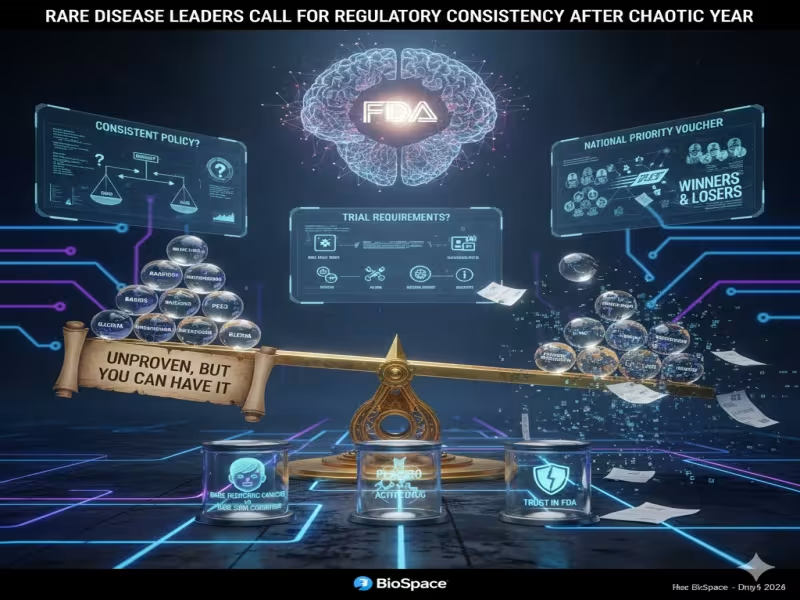
SHERIDAN, WYOMING - December 8, 2025 - After a year of mixed signals from U.S. regulators, rare disease executives and policy experts are urging the FDA to match its pro-innovation rhetoric with clearer, more consistent rules for approvals, arguing that uncertainty around evidence standards is starting to chill investment and slow the next wave of therapies.
Mixed Messages from an Activist, Rare-Disease-Friendly FDA
Under Commissioner Marty Makary and CBER director Vinay Prasad, the FDA has made high-profile statements in favor of easing market access for rare disease treatments and even floated a "plausible mechanism" pathway for ultrarare conditions. Yet in practice, sponsor experience has been uneven.
In 2025 alone, the agency approved therapies for Barth syndrome and glioma while rejecting candidates for advanced melanoma and pyruvate dehydrogenase complex deficiency, and placed uniQure's Huntington's gene therapy into regulatory limbo. "I see the breakdown as we don't have a consistent policy for relentlessly progressive diseases," consultant and FDA Matters author Steven Grossman said during a recent BioSpace webinar. "We need to have a consistent policy when to say, 'Yes, unproven, but you can have it,' and 'No, unproven makes enough of a difference here.'"
The Cost of Uncertainty for Developers and Investors
For companies trying to plan multi-year development and financing strategies in indications with tiny patient populations, unpredictable regulatory lines are a structural risk. "I think, like anything, when there's uncertainty, people tend to shy away from working in that space, investing in that space," said Mark Veich, CEO of Advancium Health Network. "If there could be some standardization in this kind of rare disease space, I think everybody wins."
John Stanford, founder and executive director of Incubate, cautioned that standardization is hard when "rare disease" spans everything from ultrarare metabolic conditions to more prevalent neuromuscular disorders. Still, companies are looking for clearer expectations on trial size, endpoints and the role of real-world evidence so they can design programs with a higher probability of regulatory success.
Trial Design, Natural History and the Ethics of Placebo
One flashpoint is how the agency weighs natural history studies and real-world data versus randomized placebo-controlled trials. Debates over natural history comparisons have sat at the center of both uniQure's AMT-130 in Huntington's disease and Biohaven's troriluzole in spinocerebellar ataxia, where previous agreements appeared to shift late in the review process.
Veich argued that wider use of real-world data instead of placebo could accelerate enrollment and reduce the ethical burden on families who fear being randomized away from a promising investigational therapy. Ultragenyx CEO Emil Kakkis underscored the reality that many Phase III programs already carry signals of benefit: "The problem is, in reality, most things that go into Phase III have had a Phase II study and have some evidence that maybe the drug might work. Otherwise, they wouldn't invest in Phase III to begin with."
Perceptions of Favoritism Across High-Profile Diseases
Stakeholders also question whether some conditions receive more regulatory flexibility than others. Recent histories in Duchenne muscular dystrophy (DMD) and ALS highlight the tension. Sarepta won approval for Vyondys 53 in 2019 after an initial rejection and saw a voluntary hold on gene therapy Elevidys lifted less than a week after halting shipments due to patient deaths, while BrainStorm's ALS candidate NurOwn remains stalled after a negative advisory vote.
Grossman argued that "the rules are completely arbitrary," asking, "Why does DMD get a little extra consideration, but maybe not ALS?" Veich countered that media visibility may be shaping perception more than policy, noting that diseases like ALS, DMD and SMA "are featured in the news more often than an orphan disease." While he does not believe "the FDA is giving them any favoritism," he emphasized that "The FDA first and foremost, in my view, is just making sure that patients are safe."
'Winners and Losers' in a Voucher-Driven, Expedited System
The Commissioner's new National Priority Voucher (CNPV) program, which can compress reviews from 10-12 months to as little as one to two months for assets aligned with "U.S. national priorities," is sharpening the divide between perceived winners and losers. "We seem to be in a winners and losers moment," Stanford said. "If we're trying to build a business plan on whether or not we will be in the FDA Commissioner's good graces, that is not something that a venture model is great at betting on."
Richard Pazdur, who recently filed retirement papers after a brief tenure as CDER director, has questioned the safety and even legality of aggressive expedited pathways, warning that compressing reviews for some drugs inevitably deprioritizes others. At the same time, high-profile rejections such as Replimune's RP1 in advanced melanoma-and the severe market reactions that followed-illustrate how fast regulatory reversals can cascade through the funding ecosystem.
Rebuilding Predictability and Trust in Rare Disease Approvals
Industry leaders broadly agree that the FDA must balance speed with rigor. "What we also don't want to do is move medicines that don't work along too quickly and weaken confidence in the whole system," Stanford said, noting that skepticism fueled by high-profile post-approval failures is feeding broader doubts about the agency's decisions.
For rare disease sponsors and investors, the path forward will depend less on new one-off initiatives and more on clear, durable guidance around acceptable endpoints, data sources and risk thresholds for relentlessly progressive conditions. Without that, the sector risks losing momentum just as decades of biology, gene therapy and precision medicine work begin to converge into viable therapeutic candidates.
For further perspective on evolving FDA rare disease frameworks, sponsors and investors should monitor official FDA guidances and advisory proceedings on accelerated approval, natural history evidence and national priority pathways.