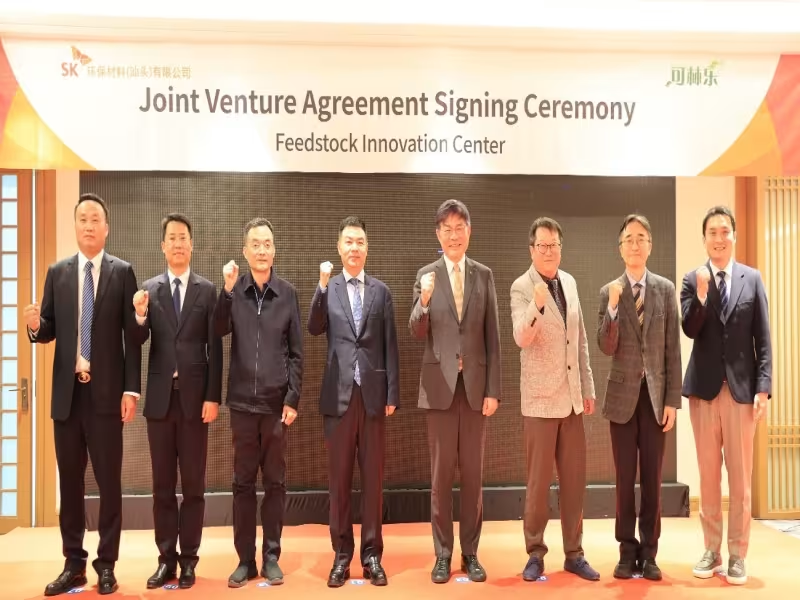
SHERIDAN, WYOMING - December 10, 2025 - SK Chemicals is moving to secure full control over its circular plastics value chain by vertically integrating feedstock sourcing through a new joint venture and Feedstock Innovation Center (FIC) in China, positioning its depolymerization-based chemical recycling business for stronger cost competitiveness and supply stability across Asia-Pacific.
From Depolymerization Pioneer to Fully Integrated Circular Plastics Player
SK Chemicals has signed a joint venture agreement with Shaanxi-based recycler Kelinle to build the Feedstock Innovation Center, a dedicated facility for processing waste plastics into recycled raw materials. Located on an idle 13,200 m² site in Weinan, Shaanxi Province, the FIC will convert end-of-life plastics into PET pellets that feed SK Chemicals' depolymerization process.
Once operational in the second half of 2026, the FIC will give SK Chemicals a value chain that stretches from the collection and processing of waste plastics through depolymerization and production of recycled materials. Among domestic chemical players pursuing depolymerization-based recycling, SK Chemicals becomes the first in Korea to establish a corporate entity that also owns facilities for sourcing and processing waste plastics.
Feedstock Innovation Center Targets Hard-to-Recycle Textiles and Fines
Unlike traditional mechanical recyclers that depend mainly on clear PET bottles, the FIC is being designed to handle challenging waste streams such as end-of-life textiles, discarded blankets and fines generated during PET-bottle shredding. Using SK Chemicals' pre-treatment and process technology, Kelinle's local network will secure feedstock that is typically incinerated or landfilled.
The center will start with around 16,000 tons per year of PET pellet capacity and ramp up to about 32,000 tons annually, supplying most of the feedstock required by SK Shantou, SK Chemicals' chemical recycling production subsidiary in China. This model supports both circularity and raw material diversification, while freeing the company from competition for high-quality bottle-grade PET that is in growing demand worldwide.
Reducing Feedstock Volatility and Improving Cost Competitiveness
In SK Chemicals' depolymerization-based circular recycling model, waste plastics effectively replace crude oil as a primary raw material. That makes stable access to low-cost, reliable feedstock a strategic requirement rather than a secondary concern. Today, many recycled-plastics producers procure waste plastics from external suppliers and are exposed to sharp price swings driven by collection conditions, regulations and rising global demand for recycled content.
By sourcing difficult-to-recycle inputs such as blankets and fiberfill, the FIC aims to reduce both volatility and absolute feedstock cost. These materials generally trade at a discount to clear PET bottles but require advanced technology to convert back into usable feedstock. SK Chemicals expects that a fully ramped FIC could secure a stable supply of waste plastics for its circular recycling business while cutting raw material costs by around 20%.
Scaling Depolymerization to Unlock New Waste Streams
As the first company in the world to commercialize depolymerization-based chemical recycling, SK Chemicals has already demonstrated that discarded banners, fabrics and colored PET bottles can be broken down to molecular-level feedstock and repolymerized into high-quality plastics. Compared with mechanical recycling, which relies on shredding and reprocessing, depolymerization enables repeated recycling without quality degradation and offers advantages in hygiene-sensitive applications.
Ahn Jae-hyun, CEO of SK Chemicals, said, "With the FIC, we have secured a complete recycling value chain that extends from depolymerization and material production to feedstock sourcing. The cost advantage gained by turning hard-to-recycle wastes such as discarded blankets into resources will help break down the price barrier of recycled plastics, which has historically been higher than petroleum-based materials."
Globally, an estimated 4.6 million tons of bedding are discarded each year, with recycling rates below 1%. By tapping this waste stream and similar textile-based inputs, SK Chemicals is targeting both emissions reduction and a structural improvement in recycled plastics economics.
Building an Asia-Pacific Hub for Circular Recycling Technology
The new FIC complements SK Chemicals' broader circular recycling footprint. In 2023, the company established a chemical recycling-based production subsidiary in Shantou, China, to commercialize r-BHET and CR-PET as a global hub for circular materials. In Korea, its Recycle Innovation Center (RIC) in Ulsan links depolymerization pilot facilities directly with copolyester production, creating a research-to-production bridge that accelerates technology transfer into commercial lines.
Kelinle, SK Chemicals' JV partner in Shaanxi, brings a decade of plastics recycling experience in the local market, including collection and processing of waste plastics into PET flakes, dedicated recycling R&D staff and 12 recycling-related patents through collaboration with Xi'an University of Technology. Together, the partners are building a feedstock platform that can support SK Chemicals' long-term ambitions in circular plastics across Asia-Pacific and beyond.
For more information on SK Chemicals' circular recycling initiatives, please refer to the company's official website.