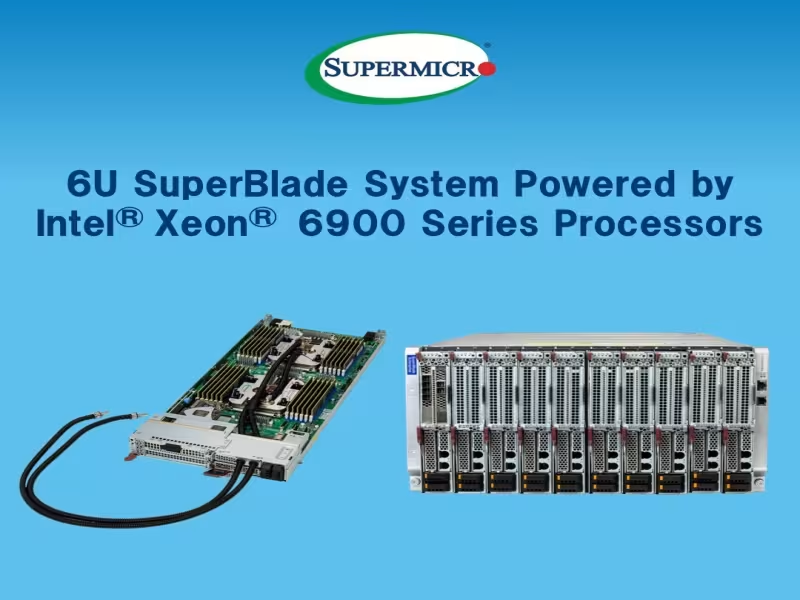
SHERIDAN, WYOMING - January 1, 2026 - Supermicro has introduced a new 6U SuperBlade configuration powered by Intel Xeon 6900 series processors, targeting higher compute density and improved space and power efficiency for modern data center deployments.
Product Scope and Target Workloads
Supermicro, which positions itself as a total IT solution provider for AI, cloud, storage, and 5G/edge, announced the latest addition to its SuperBlade family: the SBI-622BA-1NE12-LCC. The company describes it as a high-density blade server that supports both air cooling and direct liquid cooling options, with the stated goal of maximizing performance per watt and per square foot.
The platform is positioned for demanding HPC and AI workloads, with Supermicro specifically referencing use cases including manufacturing, financial services, scientific research, and energy and climate & weather modeling. For infrastructure decision-makers, the message is clear: the system is designed to concentrate compute into a smaller footprint while retaining operational control and serviceability.
Density Gains and Rack-Level Footprint
The 6U SuperBlade is presented as a consolidation play for facilities under pressure to expand compute capacity without expanding physical space. Supermicro states the design can reduce cabling by up to 93% and consume up to 50% less space than traditional rackmount servers, while also eliminating the need for a deep rack by using a 32-inch depth enclosure that fits in a standard 19-inch rack.
From a modernization standpoint, these claims map directly to common constraints in existing data halls: limited rack depth, constrained cooling corridors, and the operational complexity that grows with cable density. The stated reductions, if achieved in a given environment, can translate into faster installs, cleaner maintenance windows, and more predictable changes at scale.
Cooling Configurations for Air and Liquid Strategies
Supermicro is offering the platform with both air-cooled and direct liquid-cooled configurations to align with mixed cooling strategies across global data center fleets. The company notes that air cooling supports 6U 5 nodes, while liquid cooling supports 6U 10 nodes. It also states that direct liquid cooling can be configured with CPU-only cold plates or CPU/DIMM/VRM cold plates.
For operators, the practical takeaway is flexibility: a single blade architecture can be aligned to facilities that are still air-first and to sites that are actively shifting to liquid-assisted cooling for higher-density compute zones. This matters for phased rollouts, where hardware standardization can reduce training and spares complexity even while cooling infrastructure evolves.
Shared Resources and Remote Management Controls
A core element of the SuperBlade value proposition is the use of shared power supplies and fans, along with integrated chassis management and networking. Supermicro states that its chassis management module provides remote control of individual server blades, power supplies, cooling fans, and networking switches, and supports capabilities such as power capping, power allocation management, remote reboot/reset, and remote access to BIOS configuration and operating system console information via SOL or embedded KVM.
For enterprise IT and colocation operators, these management features are often as important as raw performance. Centralized control can improve uptime discipline, reduce hands-on time for routine actions, and support tighter governance for power budgets in multi-tenant or high-utilization environments.
Configuration Highlights for Buyers and Integrators
Supermicro's published specifications emphasize density, memory capacity, storage flexibility, and high-speed networking options. Key points in the announcement include:
- Dual Intel Xeon 6900 series processors per blade, with up to 128 P-cores per CPU and up to 256 P-cores per blade
- Up to 500W TDP per CPU
- One 6U enclosure supports up to 10 blades, with up to 25,600 high-performance cores per rack
- Up to 24 DIMM slots per blade, supporting up to 3TB of 6400MT/s DDR5 RDIMM or 1.5TB of 8800MT/s DDR5 MRDIMM
- Storage support including up to four PCIe 5.0 NVMe SSDs, two hot-swap E1.S SSDs, and two M.2 SSDs
- Integrated networking with two 25G Ethernet switches and 100G uplinks in the enclosure
Operational Impact and Procurement Considerations
Supermicro frames the platform as a way to lower operating costs and power consumption without compromising performance, primarily by consolidating compute and reducing physical and cabling overhead. For procurement and infrastructure teams, the decision typically hinges on fit to existing rack standards, cooling readiness, network architecture alignment, and service operations.
The most relevant business question is not only performance, but how quickly teams can deploy and maintain dense clusters while preserving predictability. Platforms that combine density with centralized management and hot-swappable design can reduce the friction of scaling, especially when the workload roadmap spans AI, HPC, and mixed enterprise compute in the same footprint.
Learn more at https://www.supermicro.com/en/products/superblade/module/sbi-622ba-1ne12-lcc.php