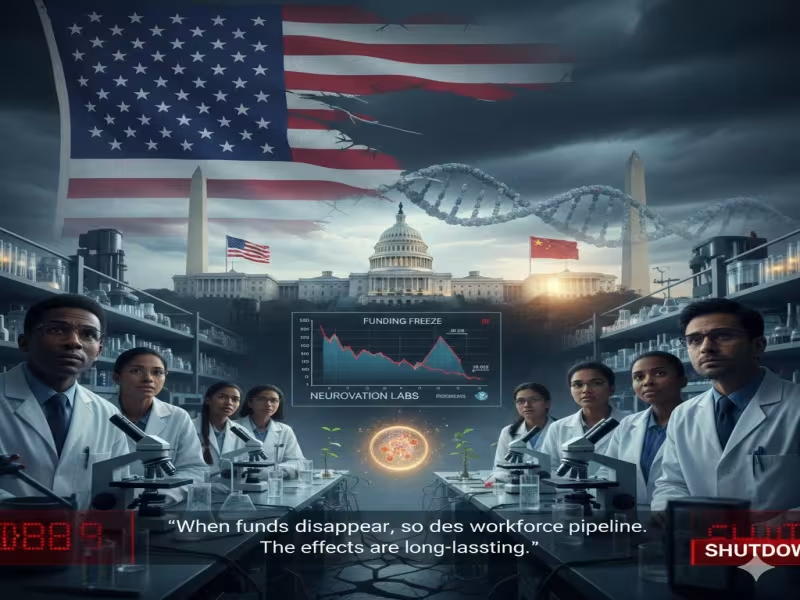
SHERIDAN, WYOMING - December 2, 2025 - As the United States grapples with record-setting government shutdowns and budget fights, the country's biotech and research ecosystem is confronting a deeper structural problem: federal science funding is increasingly unstable, putting early-stage innovation, talent pipelines and long-term competitiveness at risk. For an industry built on long horizons and high-risk discovery, interruptions to programs such as NIH grants and Small Business Innovation Research (SBIR) contracts are more than a temporary setback-they threaten the foundations of America's leadership in biopharma innovation.
Federal science funding as the backbone of U.S. biopharma
Since World War II, U.S. public funding has underpinned breakthrough advances in public health, national security and economic growth. The early, risky research that eventually leads to cancer therapies, vaccines or transformative obesity and diabetes drugs almost always begins with NIH-backed, peer-reviewed science rather than a commercial profit plan.
Private capital typically enters later, once risk has been reduced and timelines are clearer. Especially in areas such as neuroscience, rare diseases or complex diagnostics, early research is often too uncertain and long-term for venture investors. That is precisely why NIH grants and SBIR contracts have served as the world's most powerful early-stage innovation incubator-bridging the gap from basic discovery to viable biopharma pipelines.
"My company, Neurovation Labs, was fortunate to be funded for nearly five years by multiple defense SBIRs and federal awards, which kick-started our precision neuromedicine pipeline. That kind of public investment gave us the time and support to pursue a promising idea and develop it into a real solution with the potential to improve tens of millions of lives." Stories like this have historically been common across U.S. biotech.
Shutdowns, freezes and a growing funding cliff
Recent political gridlock has exposed how fragile this model has become. The 43-day government shutdown that ended earlier this month, alongside the NIH funding freeze triggered by the budget impasse, halted new grants, paused peer review operations and led to layoffs across the research ecosystem. The NIH now faces a significant backlog, stretching timelines for already delayed projects.
For early-stage companies, months-long interruptions can be fatal. "Such pauses in federal funding mechanisms freeze the biotech pipeline at its earliest stage, halting the critical, high-risk research that must begin long before any medicine can reach a patient." When milestones slip and cash runways shorten, investors may step back and programs can be cancelled outright. What appears as a short-term political standoff can, in practice, terminate promising therapies before they ever reach the clinic.
Across the country, translational research-which connects academic discovery to commercial development-is stalling. Startups find it harder to de-risk programs to the point where private investors will engage, increasing their dependence on reliable public funding. Without a functioning NIH and predictable SBIR pipeline, many will simply run out of time and money.
Talent drain and the weakening of the research pipeline
The impact of federal cuts reaches far beyond any single company. NIH funding is the backbone of the scientific workforce, supporting fellowships, training grants and early-career development for researchers who will drive the next generation of Biotech & Research innovation in the United States.
When grants dry up or become erratic, PhD graduates and postdocs receive a clear message: science is a precarious career. As early-career scientists leave the field for more stable sectors, the workforce pipeline erodes. The damage is cumulative and often invisible in the short term, yet it compounds over years as fewer experts remain to lead labs, found startups or translate discoveries into therapies.
The opinion from Neurovation Labs' leadership underscores that "when those funds disappear, so does the workforce pipeline as researchers, especially early-career scientists, leave the field. The effects may not be obvious overnight, but they are real, and they are long-lasting."
Global competitors step up as U.S. falters
While U.S. funding becomes more volatile, international competitors are stepping up their investment. China, the European Union and other regions are expanding public R&D budgets, building robust innovation clusters and actively attracting global talent. For multinational investors and researchers, the choice of where to place long-term bets increasingly depends on the stability and predictability of local science funding.
If the United States continues down a path of shutdowns, freezes and chronic underinvestment, it risks ceding the innovation leadership it has built over decades. The concern is not theoretical: biopharma pipelines, clinical trial decisions and site selection for new facilities can all shift toward ecosystems where public funding is seen as a strategic asset rather than a negotiating chip in budget negotiations.
"Science does not stop being important when budgets get tight. In fact, that is when smart investment matters most." For policy-makers, this is a warning that cutting or destabilizing science budgets may save money on paper while undermining long-term competitiveness, public health and national security.
What biotech leaders and policymakers need to do next
For small biotechs like Neurovation Labs-focused on precision neuromedicines for mental health disorders such as PTSD-consistent federal partnership is not a bonus; it is a requirement to keep high-risk, high-impact programs alive. "The future of American innovation does not start in a boardroom. It starts in a lab. Today's investment leads to tomorrow's breakthroughs, and if we abandon that investment now, we will lose out on untold treatments and cures."
Biotech executives, investors and research leaders will need to step up their engagement with Washington, making the economic and societal case for stable NIH and SBIR funding. At the same time, they must plan for funding volatility-diversifying sources where possible, building contingency into timelines and collaborating through consortia to maintain momentum in critical research areas.
Ultimately, the question for the United States is whether it still views science as a national imperative. If it does, then insulating core research budgets from political brinkmanship is no longer optional-it is a strategic necessity to protect lives, talent and long-term leadership in global biopharma innovation.
To safeguard the future of American biotech innovation, industry leaders, researchers and investors must work together with policymakers and associations to secure stable, long-term federal support for science.