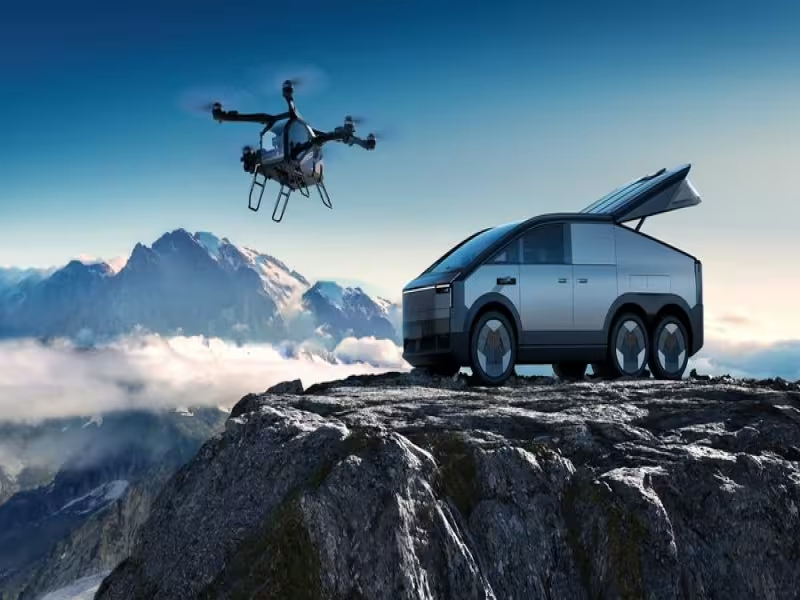
SHERIDAN, WYOMING - December 15, 2025 - XPENG AEROHT, the flying car affiliate of Chinese EV maker XPENG, has begun trial production at what it describes as the world's first intelligent factory for mass-produced flying cars-an operational milestone as next-generation mobility moves from prototypes to industrial output.
Trial production signals a commercialization inflection point
The company started trial production on November 3, 2025, positioning the facility as a bridge between engineering validation and repeatable manufacturing. For the broader eVTOL and "low-altitude mobility" ecosystem, factory readiness matters because it shifts the discussion from flight demonstrations to supply chains, quality systems, and scalable assembly-areas that typically determine whether new vehicle categories can reach customers on schedule.
Factory scale and throughput targets set a new benchmark
Located in Guangzhou's Huangpu district in Guangdong Province, the plant spans 120,000 square meters and has already rolled out the first detachable electric aircraft for its modular flying car, the "Land Aircraft Carrier." The facility is designed for an annual production capacity of 10,000 detachable aircraft modules, with an initial capacity of 5,000 units.
Once fully operational, XPENG AEROHT says it will be capable of assembling one aircraft every 30 minutes. If achieved, that pace would set a meaningful benchmark for an industry that is still defining how to industrialize air modules with automotive-like repeatability.
A modular "road + air" design targets practical deployment
The Land Aircraft Carrier combines a six-wheel ground vehicle-described as a "mothership"-with a detachable electric vertical take-off and landing (eVTOL) aircraft. This modular approach is strategically relevant because it aims to reduce friction in real-world use: the ground vehicle can handle road travel and storage while the air module covers the flight segment.
XPENG AEROHT highlights both automatic and manual flight modes for the eVTOL aircraft. In automatic mode, the system enables smart route planning alongside one-touch take-off and landing-capabilities that typically matter for operator training time and repeatable mission execution.
Road-legal dimensions and parking compatibility address buyer concerns
Beyond the flight experience, the ground vehicle's road practicality is positioned as a core adoption lever. At about 5.5 meters long, the vehicle can be driven on public roads with a standard licence and parked in regular spaces. For fleet buyers and early adopters, these details directly affect deployment economics-reducing the need for specialized transport equipment or dedicated storage footprints.
Demand signals and 2026 delivery timeline raise execution stakes
XPENG AEROHT said it has secured orders for nearly 5,000 flying cars since the product release, with mass production and delivery scheduled for 2026. The combination of early order volume and a stated delivery window increases the operational stakes: the ramp must balance output speed with quality, reliability, and service readiness-especially as aviation-adjacent products face high expectations around safety and maintenance discipline.
What the market will watch next
As the category matures, key commercialization questions extend beyond factory output, including: operational permissions, flight rules, and the ecosystem required for routine use. From a B2B perspective, the most immediate opportunities tend to emerge around manufacturing partners, component suppliers, infrastructure planning, and fleet operations models aligned with regulated environments.
For full product information on the Land Aircraft Carrier modular flying car, visit https://www.aridge.com/x3.