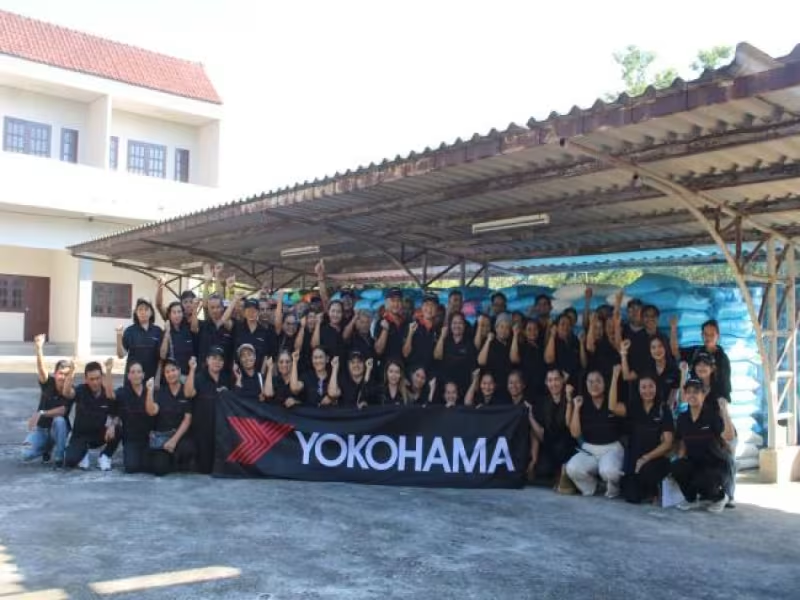
SHERIDAN, WYOMING - December 26, 2025 - Yokohama Rubber and Thailand's Rubber Authority (RAOT) have reached a new milestone in their long-term partnership to secure sustainable natural rubber, completing their tenth joint seminar to help smallholder farmers in Surat Thani improve rubber quality, productivity and working conditions across the supply chain.
Supporting smallholders at the heart of the rubber supply chain
The latest seminar, held in December 2025, brought together around 50 farming households from the Surat Thani region, one of Thailand's core natural rubber-producing areas and home to Yokohama Rubber's processing subsidiary Y.T. Rubber Co., Ltd. The program focused on practical measures to improve yield and quality at farm level, a critical factor for tire makers who depend on consistent, traceable natural rubber as a key raw material.
Participants received targeted training on soil and plant nutrients, correct fertilizer application and how to avoid contamination by foreign matter in harvested rubber. For Yokohama Rubber, these measures are directly tied to downstream product performance and cost stability in tire manufacturing, making farmer education an integral part of its sourcing strategy rather than a corporate add-on.
Technical training plus human-rights and safety awareness
Marking the tenth seminar since the series began in 2020, this edition also broadened its scope beyond agronomy. Representatives from local government, the police and a regional hospital joined the event to address:
- Respect for the human rights of migrant and minority workers on farms
- Coexistence with local communities and social responsibility
- Transport safety in rural areas
- Occupational health and safety on rubber plantations
Feedback from farmers highlighted how unusual and valuable this integrated approach is. Many reported that, despite years of experience, this was the first time they had received systematic instruction in fertilizer use or heard directly from a major downstream manufacturer about the importance of preventing contamination in their rubber. Others emphasized how practical guidance on preventing back pain during tree tapping and dealing with poisonous insects will immediately improve day-to-day working conditions.
Putting Yokohama's sustainable rubber procurement policy into practice
The seminar series is a concrete outcome of the Memorandum of Understanding signed in 2020 between Yokohama Rubber and RAOT, which commits both parties to supporting farmer livelihoods and strengthening traceability in Thailand's natural rubber supply chain. The program operationalizes key principles from Yokohama Rubber's "Procurement Policy for Sustainable Natural Rubber," especially support for small-scale farmers and other upstream suppliers.
As a founding member of the Global Platform for Sustainable Natural Rubber (GPSNR), Yokohama Rubber is aligning these field-level initiatives with broader industry standards on environmental protection, labor conditions and supply chain transparency. The work with RAOT fits into a wider portfolio of SATREPS-backed research collaborations that tackle challenges ranging from leaf fall disease control and disease-resistant clone development to next-generation technologies for monitoring and managing rubber production at scale.
Linking sustainability commitments to long-term supply security
Natural rubber remains an irreplaceable material for tires and many other industrial products, and demand is expected to stay robust as global mobility and logistics continue to grow. At the same time, plantations face biological risks such as leaf fall disease, which has already caused serious yield losses in other producing countries. By partnering closely with Thai institutions and farmers, Yokohama Rubber seeks to stabilize both the volume and quality of natural rubber available to its factories, while also supporting more resilient rural livelihoods.
Beyond compliance and certification, the company frames these efforts as part of its broader "Caring for the Future" sustainability approach and its contribution to the UN Sustainable Development Goals. Helping farmers adopt better agronomic practices, strengthening occupational health and safety on plantations, and providing access to specialized fertilizers developed with RAOT are all intended to create shared value - supporting long-term supply security for Yokohama Rubber and higher, more stable incomes for smallholders.
Learn more about Yokohama Rubber's global activities and sustainability initiatives at https://www.y-yokohama.com/global/.