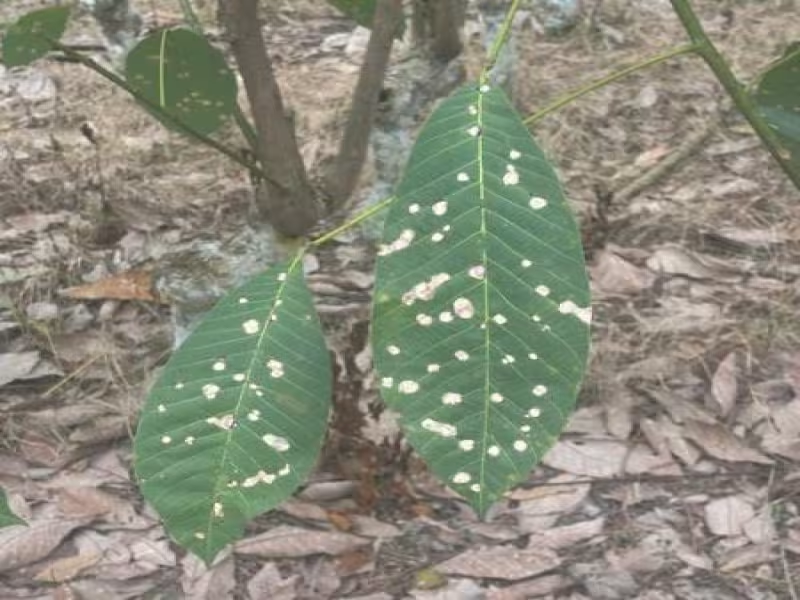
SHERIDAN, WYOMING - December 26, 2025 - Yokohama Rubber is deepening its sustainability strategy and raw materials risk management by supporting an international joint research project in Indonesia aimed at preventing rubber tree leaf fall diseases, a growing threat to global natural rubber production and the tire industry's long-term resilience.
Securing Natural Rubber at the Source in Indonesia
The company is cooperating in the multi-year project "Development of Complex Technologies for Prevention and Control of Rubber Tree Leaf Fall Diseases," which targets one of the most serious plant health challenges facing natural rubber plantations in Indonesia, the world's second-largest producer.
Leaf fall disease has become widespread in key growing regions, leading to significant yield losses and jeopardizing supply for industrial users, including tire manufacturers.
The joint initiative, conducted under Japan's Science and Technology Research Partnership for Sustainable Development (SATREPS), focuses on stabilizing production on smallholder farms, which currently account for more than 90% of Indonesia's natural rubber output. The ambition is to protect both industrial supply security and the incomes of local producers.
Joint Industry-Government-Academia Effort Under SATREPS
This research project brings together multiple Japanese and Indonesian stakeholders, including RIKEN, Gifu University, Yokohama City University, Indonesian Rubber Research Institute and Universitas Indonesia, supported by Japan's Ministry of Foreign Affairs and Ministry of Education, Culture, Sports, Science and Technology through JST and JICA.
The program combines several technology pillars to combat leaf fall disease:
- Development of chemical candidates for pesticides targeting rubber tree leaf fall pathogens
- Creation of novel microbial biofungicides as biological control tools
- Breeding and selection of disease-resistant rubber tree clones
- Use of satellite and drone imagery to detect infection hotspots early
- Establishment of next-generation prevention and control systems and supporting social infrastructure across Indonesia
This integrated approach is designed to move beyond short-term interventions and build a durable framework for disease monitoring, response and resilient rubber production.
Yokohama's Role: From Lab Validation to Field Impact
Yokohama Rubber has participated as a cooperating corporation since the project's launch in 2020. Since 2024, the company has focused on validating that the pesticide candidates identified in the program do not compromise natural rubber quality.
Field evaluations on large plantations have shown that when properly applied, selected pesticides do not adversely affect the properties of raw natural rubber or vulcanized rubber products. Building on these results, Yokohama is now helping extend assessments to the smallholders that are the primary target of the project, ensuring that real-world application at farm level remains compatible with demanding tire performance requirements.
This work directly supports Yokohama's "Procurement Policy for Sustainable Natural Rubber," which includes a commitment to back farmers and stakeholders throughout the supply chain. By integrating scientific validation, practical field trials and supply chain engagement, the company aims to help create a more sustainable, resilient and traceable natural rubber ecosystem.
Innovation Beyond Disease Control: Rubber Seeds and Green Products
The company's role in SATREPS is not limited to disease management. Yokohama Rubber also participates as an official partner in a separate SATREPS research project, "Utilization Technology of Rubber Seeds for Green Products to Mitigate Global Warming and Plastic Pollution."
By developing technologies that repurpose rubber seeds-typically an underused by-product-into green materials, this program complements the disease-control project and extends the value of natural rubber cultivation into new decarbonization and circular-economy applications.
Combined, these initiatives point toward a broader innovation roadmap in which:
- Natural rubber production is stabilized through advanced plant health and early-detection technologies
- Smallholders benefit from improved productivity and more predictable incomes
- New bio-based materials derived from rubber cultivation contribute to climate mitigation and reduced plastic waste
"Caring for the Future": Linking Sustainability and Business Continuity
Under its sustainability slogan "Caring for the Future," Yokohama Rubber is positioning these projects as core to both its ESG commitments and its long-term business continuity. Natural rubber remains an indispensable raw material for high-performance tires, and climate change, plant disease and social pressures are intensifying supply risk.
By investing in collaborative research that addresses disease threats at source, supports Indonesian smallholders and opens up new pathways for green product innovation, the company is aligning its procurement strategy with broader social and environmental outcomes. Over time, this is expected to translate into a more secure, sustainable and competitive supply base for Yokohama's global tire operations.
For more information about Yokohama Rubber's global business and sustainability initiatives, visit https://www.y-yokohama.com/global/.