Biotech & Research

Building the Next Generation of Biologics: How Protein Engineering Platforms Are Catching Up with Complexity

Submitted by fairsonline_team on
Image
Building the Next Generation of Biologics: How Protein Engineering Platforms Are Catching Up with Complexity

SHERIDAN, WYOMING - December 2, 2025 - As bispecifics, antibody-drug conjugates (ADCs), protein degraders and AI-designed mini-proteins move rapidly into clinical development, discovery teams are confronting a new bottleneck: not target ideas, but the practical engineering and scalable production of molecules that strain conventional biologics workflows.

From monoclonals to a radically more complex biologics toolbox

Monoclonal antibodies still anchor the biologics market, with more than 160 FDA approvals and a dominant share of global drug revenues. But the modality mix is shifting fast. More than 200 ADCs are now in clinical stages, bispecific approvals have climbed to 19 with sales above $12 billion in 2024, and regulators are increasingly supportive of novel protein formats.
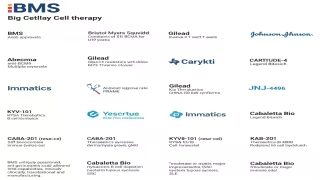

Six Cell Therapy Holdouts Double Down on CAR T and Autoimmune Plays as Big Pharma Retreats

Submitted by fairsonline_team on
Image
Six Cell Therapy Holdouts Double Down on CAR T and Autoimmune Plays as Big Pharma Retreats

SHERIDAN, WYOMING - December 2, 2025 - As several large pharmas pull back from cell therapy, a core group of biopharma players is doubling down on CAR T and next-generation approaches, positioning themselves to capture long-term value in oncology and autoimmune disease even as near-term sentiment cools.

Big pharma exits reshape expectations, not potential

Over the past year, the cell therapy field has seen a string of high-profile retreats. Takeda halted new investments in the modality and is offloading its pipeline and platforms after more than eight years of heavy spending. Novo Nordisk followed by terminating all cell therapy work, including a type 1 diabetes program, with nearly 250 roles cut. Belgian biotech Galapagos also shut down its cell therapy business after failing to find a buyer.

HAE Market Pivots to RNA and Gene Therapies as Patient 'Stickiness' Slows Uptake

Submitted by fairsonline_team on
Image
HAE Market Pivots to RNA and Gene Therapies as Patient ‘Stickiness’ Slows Uptake

SHERIDAN, WYOMING - December 2, 2025 - A wave of first-in-class hereditary angioedema (HAE) therapies is reshaping the U.S. Biotech & Research landscape, but questions remain over how quickly clinicians and patients will adopt these options in an already well-served rare disease market.

New approvals expand hereditary angioedema treatment choices

The HAE pipeline has accelerated dramatically, moving from basic C1 esterase inhibitors to sophisticated RNA-targeting and gene-editing approaches. The disease's life-threatening swelling attacks, including airway involvement, have long justified investment in both acute and prophylactic care, with the first FDA-approved preventive and on-demand therapies arriving in 2008 and 2009.

U.S. Biotech at Risk: How Federal Budget Cuts Undermine Innovation Leadership

Submitted by fairsonline_team on
Image
U.S. Biotech at Risk: How Federal Budget Cuts Undermine Innovation Leadership

SHERIDAN, WYOMING - December 2, 2025 - As the United States grapples with record-setting government shutdowns and budget fights, the country's biotech and research ecosystem is confronting a deeper structural problem: federal science funding is increasingly unstable, putting early-stage innovation, talent pipelines and long-term competitiveness at risk. For an industry built on long horizons and high-risk discovery, interruptions to programs such as NIH grants and Small Business Innovation Research (SBIR) contracts are more than a temporary setback-they threaten the foundations of America's leadership in biopharma innovation.

Federal science funding as the backbone of U.S. biopharma

Scaling Health Innovation with Startups and Universities: Nestlé Health Science Targets Women's Health and Longevity

Submitted by fairsonline_team on
Image
nestle

SHERIDAN, WYOMING - November 25, 2025 - Nestlé Health Science is deepening its open innovation strategy in nutrition and health through a series of academic and startup collaborations focused on women's health, healthy longevity and weight management, positioning itself at the center of fast-growing therapeutic nutrition markets. By linking university-based science, entrepreneurial talent and its own R&D capabilities, the company aims to accelerate the translation of emerging technologies into differentiated nutritional solutions for consumers and patients.

Moderna Narrows Losses as Cost-Cutting Strategy Begins to Stabilize Financial Outlook

Submitted by J. Mikhail on
Image
Moderna Narrows Losses as Cost-Cutting Strategy Begins to Stabilize Financial Outlook

SHERIDAN, WYOMING - November 10, 2025 - Moderna's latest quarterly report signals cautious optimism for the biotech sector, as the company's cost-reduction campaign shows measurable progress in curbing financial losses. The mRNA innovator reported a $200 million net loss for the third quarter-its fourth consecutive decline-but markedly smaller than previous quarters. Executives emphasized that the company is regaining operational balance through disciplined expense management and diversification beyond COVID-19 vaccines.

Cost Discipline Accelerates Turnaround Momentum

After steep losses of $1 billion in the first quarter and $800 million in the second, Moderna's third-quarter results demonstrate its most significant improvement to date. The company's leadership attributes the recovery to a sweeping cost-cutting plan that has exceeded expectations.