Market Trends & Strategy

Vaccine Policy Turmoil: How the Prasad Memo Exposed Regulatory Rifts and Rattled mRNA Markets

Submitted by fairsonline_team on
Image
Vaccine Policy Turmoil: How the Prasad Memo Exposed Regulatory Rifts and Rattled mRNA Markets

SHERIDAN, WYOMING - December 2, 2025 - A leaked memo from FDA vaccine chief Vinay Prasad alleging that COVID-19 vaccines caused the deaths of 10 children has triggered a sharp backlash from scientific experts and investors, underscoring deep tensions inside U.S. vaccine regulation and adding fresh volatility for mRNA players Moderna and BioNTech.

An internal memo with external market consequences

In a six-page document titled "Deaths in children due to COVID-19 vaccines and CBER's path forward," Center for Biologics Evaluation and Research head Vinay Prasad claimed that an internal investigation had identified 10 child deaths "linked" to COVID-19 vaccination, based on reports in the Vaccine Adverse Events Reporting System (VAERS). The memo, published by The Washington Post, did not provide specific data, case details or manufacturer names.

Imvax Seeks FDA Path for IGV-001 After 6-Month Survival Gain in Glioblastoma

Submitted by fairsonline_team on
Image
Imvax Seeks FDA Path for IGV-001 After 6-Month Survival Gain in Glioblastoma

SHERIDAN, WYOMING - December 2, 2025 - Imvax is moving its autologous glioblastoma immunotherapy IGV-001 toward the FDA, despite a missed primary endpoint in Phase IIb, betting that a six-month overall survival benefit and a novel "synergistic" treatment concept will resonate in a setting where outcomes have barely budged in two decades.

Phase IIb data highlight survival benefit despite PFS miss

In a mid-stage trial of 99 patients with newly diagnosed glioblastoma, Imvax evaluated IGV-001, a biologic-device combination, against placebo. While the study did not achieve its primary endpoint of improving progression-free survival, the company reported a median overall survival of 20.3 months in the treatment arm-around six months longer than in the control group.

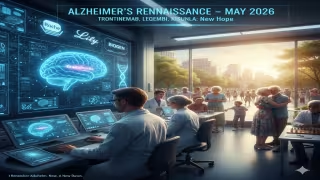
Roche's Alzheimer's Comeback Signals a New Competitive Phase for Disease-Modifying Therapies

Submitted by fairsonline_team on
Image
Roche’s Alzheimer’s Comeback Signals a New Competitive Phase for Disease-Modifying Therapies

SHERIDAN, WYOMING - December 2, 2025 - After years of volatility in Alzheimer's R&D, Roche's re-emergence with positive early data for trontinemab is reshaping expectations for the next competitive cycle in disease-modifying therapies, signaling that big pharma is not done pushing for better outcomes in this high-risk, high-need market.

From Aduhelm's fallout to a more mature Alzheimer's market

The modern Alzheimer's era was defined-some would say scarred-by the 2021 approval of Biogen and Eisai's Aduhelm, a controversial and costly monoclonal antibody that ultimately failed to deliver convincing clinical benefit and was later withdrawn. The backlash damaged Biogen's reputation and, for a time, cast doubt on the entire amyloid-directed approach, raising questions about regulatory standards and payer willingness to back expensive, marginally effective therapies.

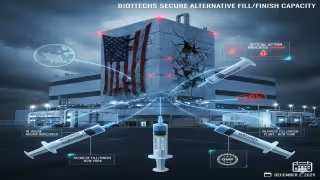
Regeneron and Scholar Rock Reroute Fill/Finish as Novo's Indiana Plant Faces FDA Heat

Submitted by fairsonline_team on
Image
Regeneron and Scholar Rock Reroute Fill/Finish as Novo’s Indiana Plant Faces FDA Heat

SHERIDAN, WYOMING - December 2, 2025 - A series of FDA findings at Novo Nordisk's Bloomington, Indiana, fill/finish facility is forcing biotechs to rethink their commercial manufacturing strategies, with Regeneron and Scholar Rock now accelerating alternative capacity plans to break regulatory logjams linked to the ex-Catalent site.

FDA scrutiny at Novo's Bloomington site triggers CRLs

The Bloomington plant, one of three former Catalent sites Novo acquired for $11 billion to support surging GLP-1 demand, has become a bottleneck rather than a release valve for some of its biopharma customers. As a CDMO hub, the facility provided fill/finish services for a range of partners, but repeated quality issues have resulted in an Official Action Indicated (OAI) classification and multiple complete response letters (CRLs) from the FDA.

Building the Next Generation of Biologics: How Protein Engineering Platforms Are Catching Up with Complexity

Submitted by fairsonline_team on
Image
Building the Next Generation of Biologics: How Protein Engineering Platforms Are Catching Up with Complexity

SHERIDAN, WYOMING - December 2, 2025 - As bispecifics, antibody-drug conjugates (ADCs), protein degraders and AI-designed mini-proteins move rapidly into clinical development, discovery teams are confronting a new bottleneck: not target ideas, but the practical engineering and scalable production of molecules that strain conventional biologics workflows.

From monoclonals to a radically more complex biologics toolbox

Monoclonal antibodies still anchor the biologics market, with more than 160 FDA approvals and a dominant share of global drug revenues. But the modality mix is shifting fast. More than 200 ADCs are now in clinical stages, bispecific approvals have climbed to 19 with sales above $12 billion in 2024, and regulators are increasingly supportive of novel protein formats.

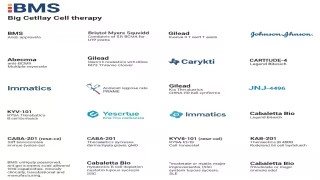
Six Cell Therapy Holdouts Double Down on CAR T and Autoimmune Plays as Big Pharma Retreats

Submitted by fairsonline_team on
Image
Six Cell Therapy Holdouts Double Down on CAR T and Autoimmune Plays as Big Pharma Retreats

SHERIDAN, WYOMING - December 2, 2025 - As several large pharmas pull back from cell therapy, a core group of biopharma players is doubling down on CAR T and next-generation approaches, positioning themselves to capture long-term value in oncology and autoimmune disease even as near-term sentiment cools.

Big pharma exits reshape expectations, not potential

Over the past year, the cell therapy field has seen a string of high-profile retreats. Takeda halted new investments in the modality and is offloading its pipeline and platforms after more than eight years of heavy spending. Novo Nordisk followed by terminating all cell therapy work, including a type 1 diabetes program, with nearly 250 roles cut. Belgian biotech Galapagos also shut down its cell therapy business after failing to find a buyer.

HAE Market Pivots to RNA and Gene Therapies as Patient 'Stickiness' Slows Uptake

Submitted by fairsonline_team on
Image
HAE Market Pivots to RNA and Gene Therapies as Patient ‘Stickiness’ Slows Uptake

SHERIDAN, WYOMING - December 2, 2025 - A wave of first-in-class hereditary angioedema (HAE) therapies is reshaping the U.S. Biotech & Research landscape, but questions remain over how quickly clinicians and patients will adopt these options in an already well-served rare disease market.

New approvals expand hereditary angioedema treatment choices

The HAE pipeline has accelerated dramatically, moving from basic C1 esterase inhibitors to sophisticated RNA-targeting and gene-editing approaches. The disease's life-threatening swelling attacks, including airway involvement, have long justified investment in both acute and prophylactic care, with the first FDA-approved preventive and on-demand therapies arriving in 2008 and 2009.

U.S. Biotech at Risk: How Federal Budget Cuts Undermine Innovation Leadership

Submitted by fairsonline_team on
Image
U.S. Biotech at Risk: How Federal Budget Cuts Undermine Innovation Leadership

SHERIDAN, WYOMING - December 2, 2025 - As the United States grapples with record-setting government shutdowns and budget fights, the country's biotech and research ecosystem is confronting a deeper structural problem: federal science funding is increasingly unstable, putting early-stage innovation, talent pipelines and long-term competitiveness at risk. For an industry built on long horizons and high-risk discovery, interruptions to programs such as NIH grants and Small Business Innovation Research (SBIR) contracts are more than a temporary setback-they threaten the foundations of America's leadership in biopharma innovation.

Federal science funding as the backbone of U.S. biopharma

Tech-Powered CPG: How AI, Analytics and Sustainable Innovation Will Shape 2026

Submitted by fairsonline_team on
Image
Tech-Powered CPG: How AI, Analytics and Sustainable Innovation Will Shape 2026

SHERIDAN, WYOMING - December 2, 2025 - As consumer packaged goods companies head into 2026, Kellanova sees technology not as a back-office enabler but as a growth catalyst connecting insight to action, purpose to performance, and innovation to impact. From agentic AI to connected commerce and smart, sustainable supply chains, the company's leadership argues that digital transformation in CPG is now about reinvention, not just modernization.

Agentic AI moves from pilots to real business impact

Agentic AI is emerging as a force multiplier across the CPG value chain, capable of analyzing real-time data, making recommendations and executing actions without constant human intervention. In practice, that means automating repetitive tasks, streamlining cross-functional workflows and reacting to market shifts with new speed and precision.

ESG Transparency Award 2025: How European Leaders Turn Sustainability Reporting into Competitive Advantage

Submitted by fairsonline_team on
Image
ESG Transparency Award 2025: How European Leaders Turn Sustainability Reporting into Competitive Advantage

SHERIDAN, WYOMING - December 2, 2025 - As regulatory expectations and investor scrutiny rise across Europe, the EUPD Group's ESG Transparency Award 2025 is spotlighting companies that no longer treat sustainability reporting as a mere compliance exercise, but as an engine for competitive differentiation and stakeholder trust. Presented in Bonn as part of this year's ESG Summit, the award recognizes more than 50 leading European companies that have embedded forward-looking ESG strategies into their organizations and communicate them transparently through robust sustainability reports.

ESG transparency moves from obligation to value driver