Healthcare & Biotech

Imvax Seeks FDA Path for IGV-001 After 6-Month Survival Gain in Glioblastoma

Submitted by fairsonline_team on
Image
Imvax Seeks FDA Path for IGV-001 After 6-Month Survival Gain in Glioblastoma

SHERIDAN, WYOMING - December 2, 2025 - Imvax is moving its autologous glioblastoma immunotherapy IGV-001 toward the FDA, despite a missed primary endpoint in Phase IIb, betting that a six-month overall survival benefit and a novel "synergistic" treatment concept will resonate in a setting where outcomes have barely budged in two decades.

Phase IIb data highlight survival benefit despite PFS miss

In a mid-stage trial of 99 patients with newly diagnosed glioblastoma, Imvax evaluated IGV-001, a biologic-device combination, against placebo. While the study did not achieve its primary endpoint of improving progression-free survival, the company reported a median overall survival of 20.3 months in the treatment arm-around six months longer than in the control group.

Roche's Alzheimer's Comeback Signals a New Competitive Phase for Disease-Modifying Therapies

Submitted by fairsonline_team on
Image
Roche’s Alzheimer’s Comeback Signals a New Competitive Phase for Disease-Modifying Therapies

SHERIDAN, WYOMING - December 2, 2025 - After years of volatility in Alzheimer's R&D, Roche's re-emergence with positive early data for trontinemab is reshaping expectations for the next competitive cycle in disease-modifying therapies, signaling that big pharma is not done pushing for better outcomes in this high-risk, high-need market.

From Aduhelm's fallout to a more mature Alzheimer's market

The modern Alzheimer's era was defined-some would say scarred-by the 2021 approval of Biogen and Eisai's Aduhelm, a controversial and costly monoclonal antibody that ultimately failed to deliver convincing clinical benefit and was later withdrawn. The backlash damaged Biogen's reputation and, for a time, cast doubt on the entire amyloid-directed approach, raising questions about regulatory standards and payer willingness to back expensive, marginally effective therapies.

Regeneron and Scholar Rock Reroute Fill/Finish as Novo's Indiana Plant Faces FDA Heat

Submitted by fairsonline_team on
Image
Regeneron and Scholar Rock Reroute Fill/Finish as Novo’s Indiana Plant Faces FDA Heat

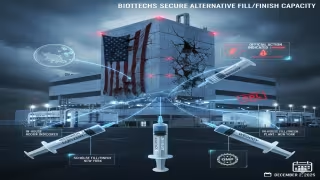
SHERIDAN, WYOMING - December 2, 2025 - A series of FDA findings at Novo Nordisk's Bloomington, Indiana, fill/finish facility is forcing biotechs to rethink their commercial manufacturing strategies, with Regeneron and Scholar Rock now accelerating alternative capacity plans to break regulatory logjams linked to the ex-Catalent site.

FDA scrutiny at Novo's Bloomington site triggers CRLs

The Bloomington plant, one of three former Catalent sites Novo acquired for $11 billion to support surging GLP-1 demand, has become a bottleneck rather than a release valve for some of its biopharma customers. As a CDMO hub, the facility provided fill/finish services for a range of partners, but repeated quality issues have resulted in an Official Action Indicated (OAI) classification and multiple complete response letters (CRLs) from the FDA.

Building the Next Generation of Biologics: How Protein Engineering Platforms Are Catching Up with Complexity

Submitted by fairsonline_team on
Image
Building the Next Generation of Biologics: How Protein Engineering Platforms Are Catching Up with Complexity

SHERIDAN, WYOMING - December 2, 2025 - As bispecifics, antibody-drug conjugates (ADCs), protein degraders and AI-designed mini-proteins move rapidly into clinical development, discovery teams are confronting a new bottleneck: not target ideas, but the practical engineering and scalable production of molecules that strain conventional biologics workflows.

From monoclonals to a radically more complex biologics toolbox

Monoclonal antibodies still anchor the biologics market, with more than 160 FDA approvals and a dominant share of global drug revenues. But the modality mix is shifting fast. More than 200 ADCs are now in clinical stages, bispecific approvals have climbed to 19 with sales above $12 billion in 2024, and regulators are increasingly supportive of novel protein formats.

AGC Biologics Tackles Speed, Scale and Yield in Next-Generation Microbial Manufacturing

Submitted by fairsonline_team on
Image
AGC Biologics Tackles Speed, Scale and Yield in Next-Generation Microbial Manufacturing

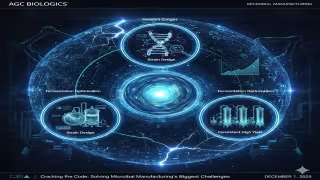
SHERIDAN, WYOMING - December 2, 2025 - Microbial fermentation is moving back to the center of biologics manufacturing strategy, and contract development and manufacturing organizations (CDMOs) like AGC Biologics are under pressure to turn the platform's greatest strength-speed-into a reproducible, industrial-scale advantage.

Microbial fermentation's resurgence - and its speed problem

Microbial systems have long been valued for fast, efficient production of biologics, and they are now seeing renewed interest for a new generation of therapies. Yet the same speed that makes microbial fermentation attractive also makes it unforgiving. Typical production runs last around 48 hours, leaving very little time to diagnose and correct process deviations once a run is underway.

Six Cell Therapy Holdouts Double Down on CAR T and Autoimmune Plays as Big Pharma Retreats

Submitted by fairsonline_team on
Image
Six Cell Therapy Holdouts Double Down on CAR T and Autoimmune Plays as Big Pharma Retreats

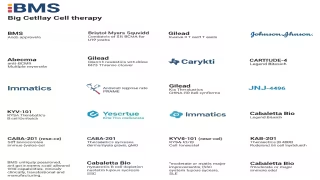
SHERIDAN, WYOMING - December 2, 2025 - As several large pharmas pull back from cell therapy, a core group of biopharma players is doubling down on CAR T and next-generation approaches, positioning themselves to capture long-term value in oncology and autoimmune disease even as near-term sentiment cools.

Big pharma exits reshape expectations, not potential

Over the past year, the cell therapy field has seen a string of high-profile retreats. Takeda halted new investments in the modality and is offloading its pipeline and platforms after more than eight years of heavy spending. Novo Nordisk followed by terminating all cell therapy work, including a type 1 diabetes program, with nearly 250 roles cut. Belgian biotech Galapagos also shut down its cell therapy business after failing to find a buyer.

HAE Market Pivots to RNA and Gene Therapies as Patient 'Stickiness' Slows Uptake

Submitted by fairsonline_team on
Image
HAE Market Pivots to RNA and Gene Therapies as Patient ‘Stickiness’ Slows Uptake

SHERIDAN, WYOMING - December 2, 2025 - A wave of first-in-class hereditary angioedema (HAE) therapies is reshaping the U.S. Biotech & Research landscape, but questions remain over how quickly clinicians and patients will adopt these options in an already well-served rare disease market.

New approvals expand hereditary angioedema treatment choices

The HAE pipeline has accelerated dramatically, moving from basic C1 esterase inhibitors to sophisticated RNA-targeting and gene-editing approaches. The disease's life-threatening swelling attacks, including airway involvement, have long justified investment in both acute and prophylactic care, with the first FDA-approved preventive and on-demand therapies arriving in 2008 and 2009.

U.S. Biotech at Risk: How Federal Budget Cuts Undermine Innovation Leadership

Submitted by fairsonline_team on
Image
U.S. Biotech at Risk: How Federal Budget Cuts Undermine Innovation Leadership

SHERIDAN, WYOMING - December 2, 2025 - As the United States grapples with record-setting government shutdowns and budget fights, the country's biotech and research ecosystem is confronting a deeper structural problem: federal science funding is increasingly unstable, putting early-stage innovation, talent pipelines and long-term competitiveness at risk. For an industry built on long horizons and high-risk discovery, interruptions to programs such as NIH grants and Small Business Innovation Research (SBIR) contracts are more than a temporary setback-they threaten the foundations of America's leadership in biopharma innovation.

Federal science funding as the backbone of U.S. biopharma

Philips debuts cloud-ready web diagnostic viewer to unify imaging access and AI workflows

Submitted by fairsonline_team on
Image
Philips debuts cloud-ready web diagnostic viewer to unify imaging access and AI workflows

SHERIDAN, WYOMING - November 25, 2025 - Royal Philips has launched Image Management 15, the next generation of its Philips Vue PACS platform, featuring a zero-footprint web diagnostic viewer that brings full radiology workstation capabilities into a standard web browser. Positioned as a cornerstone of Philips' cloud-enabled imaging informatics strategy, the solution is designed to help health systems modernize remote reading, streamline AI integration, and simplify IT across distributed radiology networks.

Anywhere, anytime diagnostic reading via the browser

The new web-based diagnostic viewer is built to address one of radiology's most persistent pain points: lost clinical time due to slow performance and fragmented remote reading setups. Delivering high-performance server-side rendering and workflow automation, it allows radiologists to access advanced clinical tools securely through a browser, without local installation.

Philips and Cortechs.ai deepen AI partnership to scale quantitative neuroimaging in MR

Submitted by fairsonline_team on
Image
Philips and Cortechs.ai deepen AI partnership to scale quantitative neuroimaging in MR

SHERIDAN, WYOMING - November 25, 2025 - Royal Philips has extended its partnership with quantitative neuroimaging specialist Cortechs.ai to integrate advanced AI-enabled neuroimaging analytics directly into Philips MR systems, giving radiologists faster, more objective and reproducible insights into brain health within their everyday workflows. By combining Philips' next-generation MR technologies with Cortechs.ai's quantitative post-processing software, the collaboration aims to set a new benchmark for precision diagnostics in neurology and strengthen Philips' position in data-driven brain imaging.

Meeting surging demand for brain MR with data-driven insight