Corporate Strategy & Transformation

How In-House 3D Printing Turns Your Dental Lab from Vendor into Strategic Partner

Submitted by fairsonline_team on
Image
How In-House 3D Printing Turns Your Dental Lab from Vendor into Strategic Partner

SHERIDAN, WYOMING - December 8, 2025 - As more practices adopt chairside 3D printing, many clinicians worry quietly about what it means for long-standing dental lab relationships-but rather than replacing labs, in-house production is reshaping them into higher-value, more strategic partnerships built around clearly defined roles and shared digital workflows.

From Full Lab Dependency to Hybrid Production

For years, the dominant model in restorative and appliance production has been full lab dependency: every crown, bridge, model, surgical guide, night guard or retainer went out the door to a third-party provider. In that setup, "Lab controls your timeline. Lab controls your cost per case. Lab capacity limits your capacity. Emergency cases wait on lab availability."

How Chairside 3D Printing with SprintRay Rewrites the Economics of Restorative Dentistry

Submitted by fairsonline_team on
Image
How Chairside 3D Printing with SprintRay Rewrites the Economics of Restorative Dentistry

SHERIDAN, WYOMING - December 8, 2025 - Chairside 3D printing has moved from conference buzzword to everyday reality in U.S. dental practices, and SprintRay is positioning its ecosystem as a way for clinics to bring production in-house, compress treatment timelines, and turn same-day crowns into a strategic differentiator rather than a marketing slogan.

From Lab Dependency to In-Practice Production

At its core, "chairside" simply means producing the restoration in your own practice while the patient is still in your care, instead of sending cases to an external lab and waiting one to two weeks. Clinically, the workflow is familiar-examination, preparation, design and cementation remain the same-but the fabrication step moves from a third party you can't control to equipment in your operatory that you can.

Kellanova's "Cool Soil Critters" Campaign Puts Soil Health at the Heart of Australia's Food Supply

Submitted by fairsonline_team on
Image
Kellanova’s “Cool Soil Critters” Campaign Puts Soil Health at the Heart of Australia’s Food Supply

SHERIDAN, WYOMING - December 8, 2025 - Kellanova is using its "Cool Soil Critters" campaign in Australia to turn an often invisible topic-soil health-into a mainstream sustainability and supply-chain conversation, linking biodiversity beneath the surface directly to crop resilience, food security and long-term brand value.

From Iconic Foods to the Health of the Soil Behind Them

As a company that depends on crops to make the foods people know and love, Kellanova is positioning soil health as a strategic asset rather than a purely agronomic concern. Through its partnership with the Cool Soil Initiative, Kellanova Australia and New Zealand (ANZ) is supporting programs that help farmers increase organic carbon levels and reduce greenhouse gas emissions on Australian farms.

With Capital Surging and Deals Advancing, Thumzup Recasts Itself as a Digital-Infrastructure Player

Submitted by fairsonline_team on
Image
With Capital Surging and Deals Advancing, Thumzup Recasts Itself as a Digital-Infrastructure Player

SHERIDAN, WYOMING - December 4, 2025 - Thumzup Media Corporation is moving quickly to shed its image as a niche social advertising startup and reposition itself as a diversified operator in digital-asset infrastructure, data-center capacity, and next-generation computation. Backed by fresh capital and a pipeline of deals, the Los Angeles-based company is steering toward businesses with more predictable cash flows and scalable hard assets.

From Social Ad Startup to Balance-Sheet Builder

Thumzup's strategic reset rests on a markedly stronger financial base. In August 2025, the company raised $50 million in a public offering, lifting total assets to approximately $52 million. That step-change in scale gives Thumzup, which previously operated with far leaner resources, a genuine platform to pursue acquisitions, infrastructure buildouts, and selective minority stakes across high-growth technology verticals.

Roche's Alzheimer's Comeback Signals a New Competitive Phase for Disease-Modifying Therapies

Submitted by fairsonline_team on
Image
Roche’s Alzheimer’s Comeback Signals a New Competitive Phase for Disease-Modifying Therapies

SHERIDAN, WYOMING - December 2, 2025 - After years of volatility in Alzheimer's R&D, Roche's re-emergence with positive early data for trontinemab is reshaping expectations for the next competitive cycle in disease-modifying therapies, signaling that big pharma is not done pushing for better outcomes in this high-risk, high-need market.

From Aduhelm's fallout to a more mature Alzheimer's market

The modern Alzheimer's era was defined-some would say scarred-by the 2021 approval of Biogen and Eisai's Aduhelm, a controversial and costly monoclonal antibody that ultimately failed to deliver convincing clinical benefit and was later withdrawn. The backlash damaged Biogen's reputation and, for a time, cast doubt on the entire amyloid-directed approach, raising questions about regulatory standards and payer willingness to back expensive, marginally effective therapies.

Building the Next Generation of Biologics: How Protein Engineering Platforms Are Catching Up with Complexity

Submitted by fairsonline_team on
Image
Building the Next Generation of Biologics: How Protein Engineering Platforms Are Catching Up with Complexity

SHERIDAN, WYOMING - December 2, 2025 - As bispecifics, antibody-drug conjugates (ADCs), protein degraders and AI-designed mini-proteins move rapidly into clinical development, discovery teams are confronting a new bottleneck: not target ideas, but the practical engineering and scalable production of molecules that strain conventional biologics workflows.

From monoclonals to a radically more complex biologics toolbox

Monoclonal antibodies still anchor the biologics market, with more than 160 FDA approvals and a dominant share of global drug revenues. But the modality mix is shifting fast. More than 200 ADCs are now in clinical stages, bispecific approvals have climbed to 19 with sales above $12 billion in 2024, and regulators are increasingly supportive of novel protein formats.

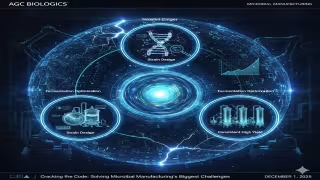
AGC Biologics Tackles Speed, Scale and Yield in Next-Generation Microbial Manufacturing

Submitted by fairsonline_team on
Image
AGC Biologics Tackles Speed, Scale and Yield in Next-Generation Microbial Manufacturing

SHERIDAN, WYOMING - December 2, 2025 - Microbial fermentation is moving back to the center of biologics manufacturing strategy, and contract development and manufacturing organizations (CDMOs) like AGC Biologics are under pressure to turn the platform's greatest strength-speed-into a reproducible, industrial-scale advantage.

Microbial fermentation's resurgence - and its speed problem

Microbial systems have long been valued for fast, efficient production of biologics, and they are now seeing renewed interest for a new generation of therapies. Yet the same speed that makes microbial fermentation attractive also makes it unforgiving. Typical production runs last around 48 hours, leaving very little time to diagnose and correct process deviations once a run is underway.

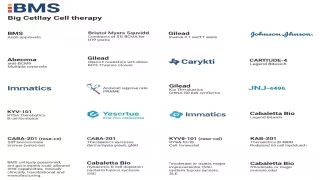
Six Cell Therapy Holdouts Double Down on CAR T and Autoimmune Plays as Big Pharma Retreats

Submitted by fairsonline_team on
Image
Six Cell Therapy Holdouts Double Down on CAR T and Autoimmune Plays as Big Pharma Retreats

SHERIDAN, WYOMING - December 2, 2025 - As several large pharmas pull back from cell therapy, a core group of biopharma players is doubling down on CAR T and next-generation approaches, positioning themselves to capture long-term value in oncology and autoimmune disease even as near-term sentiment cools.

Big pharma exits reshape expectations, not potential

Over the past year, the cell therapy field has seen a string of high-profile retreats. Takeda halted new investments in the modality and is offloading its pipeline and platforms after more than eight years of heavy spending. Novo Nordisk followed by terminating all cell therapy work, including a type 1 diabetes program, with nearly 250 roles cut. Belgian biotech Galapagos also shut down its cell therapy business after failing to find a buyer.

Tech-Powered CPG: How AI, Analytics and Sustainable Innovation Will Shape 2026

Submitted by fairsonline_team on
Image
Tech-Powered CPG: How AI, Analytics and Sustainable Innovation Will Shape 2026

SHERIDAN, WYOMING - December 2, 2025 - As consumer packaged goods companies head into 2026, Kellanova sees technology not as a back-office enabler but as a growth catalyst connecting insight to action, purpose to performance, and innovation to impact. From agentic AI to connected commerce and smart, sustainable supply chains, the company's leadership argues that digital transformation in CPG is now about reinvention, not just modernization.

Agentic AI moves from pilots to real business impact

Agentic AI is emerging as a force multiplier across the CPG value chain, capable of analyzing real-time data, making recommendations and executing actions without constant human intervention. In practice, that means automating repetitive tasks, streamlining cross-functional workflows and reacting to market shifts with new speed and precision.

DEKRA Marks 100 Years with Stable Growth and Strategic Investments in Mobility, Digital Trust and Sustainability

Submitted by fairsonline_team on
Image
DEKRA Marks 100 Years with Stable Growth and Strategic Investments in Mobility, Digital Trust and Sustainability

SHERIDAN, WYOMING - November 28, 2025 - As DEKRA concludes its 100th anniversary year, the global testing, inspection and certification (TIC) organization is reporting resilient performance, mid-single digit revenue growth and a clear strategic course focused on Mobility, Digital Trust and Sustainability despite a volatile macroeconomic and geopolitical backdrop.

Resilient TIC Performance in a Challenging Environment

In 2025, DEKRA operated against a backdrop of elevated volatility, geopolitical uncertainties and weak economic conditions in several European markets. Even so, the group expects mid-single digit revenue growth for the full year and overall stable results at the level of the previous year. In the first ten months alone, revenue growth in the core TIC business stood at around 4 percent, underscoring the robustness of its service portfolio.