Healthcare & Biotech

Canada's Fast-Track Immigration Plan for International Doctors Signals Shift in Physician Workforce Strategy

Submitted by fairsonline_team on
Image
b2b or b2c?  DÉCLARATION - L'Association médicale canadienne accueille favorablement les nouvelles mesures fédérales visant à accélérer l'intégration des médecins internationaux   News provided by Association médicale canadienne  08 Dec, 2025, 10:14 ET Share this article      OTTAWA, ON, le 8 déc. 2025 /CNW/ - L'Association médicale canadienne (AMC) accueille favorablement l'annonce faite aujourd'hui par Lena Diab, ministre de l'Immigration, des Réfugiés et de la Citoyenneté, concernant de nouvelles mesures

SHERIDAN, WYOMING - December 8, 2025 - Canada is moving to tighten the link between immigration policy and health system capacity, with the federal government announcing new measures to accelerate the arrival and integration of internationally trained physicians-and the Canadian Medical Association (CMA) signalling that the real prize will be pairing these policies with faster, more predictable credential recognition.

New Federal Pathways Aim to Bring Doctors into Practice Faster

In Ottawa, Immigration, Refugees and Citizenship Minister Lena Diab unveiled a package of measures to make it easier for international doctors to settle and work in Canada. The initiative includes a new fast-track entry program for foreign physicians currently working in the country on a temporary basis, as well as additional slots dedicated to doctors under the Provincial Nominee Program.

Rare Disease Leaders Warn FDA: Innovation Needs Predictable Rules, Not One-Off Exceptions

Submitted by fairsonline_team on
Image
Rare Disease Leaders Warn FDA: Innovation Needs Predictable Rules, Not One-Off Exceptions

SHERIDAN, WYOMING - December 8, 2025 - After a year of mixed signals from U.S. regulators, rare disease executives and policy experts are urging the FDA to match its pro-innovation rhetoric with clearer, more consistent rules for approvals, arguing that uncertainty around evidence standards is starting to chill investment and slow the next wave of therapies.

Mixed Messages from an Activist, Rare-Disease-Friendly FDA

Under Commissioner Marty Makary and CBER director Vinay Prasad, the FDA has made high-profile statements in favor of easing market access for rare disease treatments and even floated a "plausible mechanism" pathway for ultrarare conditions. Yet in practice, sponsor experience has been uneven.

FDA's One-Trial Plan Could Rewrite Global Drug Development Economics

Submitted by fairsonline_team on
Image
FDA’s One-Trial Plan Could Rewrite Global Drug Development Economics

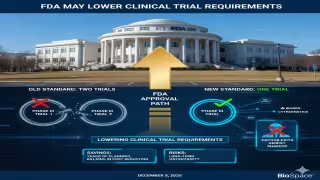
SHERIDAN, WYOMING - December 8, 2025 - The U.S. Food and Drug Administration is preparing a fundamental shift in its evidentiary standards for new drugs, with Commissioner Marty Makary signaling that a single pivotal trial could soon be sufficient for approval-a move that has roiled internal leadership, unsettled some regulators and analysts, and triggered immediate recalculations in biopharma portfolio models.

From Two Pivotal Trials to One: A Structural Break

FDA Clinical Hold on Denali's Brain-Penetrant Pompe Therapy Highlights First-in-Human Safety Scrutiny

Submitted by fairsonline_team on
Image
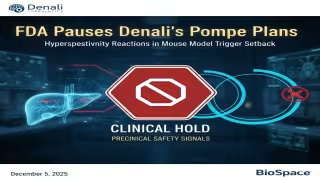
FDA Clinical Hold on Denali’s Brain-Penetrant Pompe Therapy Highlights First-in-Human Safety Scrutiny

SHERIDAN, WYOMING - December 8, 2025 - Denali Therapeutics is facing another regulatory setback after the U.S. Food and Drug Administration (FDA) placed a clinical hold on DNL952, its enzyme replacement candidate for Pompe disease, citing preclinical hypersensitivity signals and demanding protocol changes before the company can start Phase I studies.

FDA Flags Hypersensitivity Risk Before First Human Dosing

The clinical hold, disclosed in an SEC filing, stems from "hypersensitivity reactions" observed in mouse models. While the agency has not required additional non-clinical studies, it is insisting on a more conservative first-in-human plan. Denali has been asked to lower the proposed starting dose for DNL952 and implement "revised inclusion criteria, adjusted stopping rules and unspecified safety monitoring commitments" before the program can proceed.

Praxis Scores Phase II Win in Rare Epilepsies as Ulixacaltamide Tracks Toward 2026 FDA Filing

Submitted by fairsonline_team on
Image
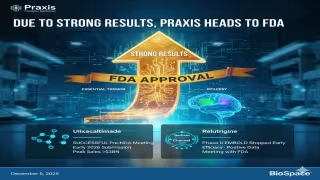
Praxis Scores Phase II Win in Rare Epilepsies as Ulixacaltamide Tracks Toward 2026 FDA Filing

SHERIDAN, WYOMING - December 8, 2025 - Praxis Precision Medicines has doubled down on its neurology strategy with back-to-back updates: a Phase II win for its sodium current blocker relutrigine in rare developmental and epileptic encephalopathies (DEE) and a "successful" pre-NDA meeting for its essential tremor candidate ulixacaltamide, positioning the Boston biotech as a potential new commercial player in both ultra-rare epilepsy and movement disorders.

Relutrigine Study Stopped Early for Efficacy in DEE

Praxis has halted its mid-stage EMBOLD trial of relutrigine early, after an independent data monitoring board recommended the study "stop the study early for efficacy." The Phase II EMBOLD study is evaluating relutrigine in patients with DEE linked to SCN8A and SCN2A mutations, a small but highly underserved genetic epilepsy population with limited therapeutic options and high unmet medical need.

Eisai Doubles Down on Tau as Alzheimer's R&D Broadens Beyond Amyloid

Submitted by fairsonline_team on
Image
Eisai Doubles Down on Tau as Alzheimer’s R&D Broadens Beyond Amyloid

SHERIDAN, WYOMING - December 8, 2025 - Days after Johnson & Johnson reported a mid-stage failure for its anti-tau antibody posdinemab, Eisai is using the Clinical Trials on Alzheimer's Disease (CTAD) 2025 conference to argue that tau is still a viable target-if drug designers hit the right part of the protein-while investors and scientists pivot their attention to inflammation and vascular pathways.

Anti-tau Setbacks Raise the Bar for New Entrants

Tau-directed drugs have been among the most high-profile disappointments in Alzheimer's disease (AD) R&D. J&J's recent miss with posdinemab follows last year's Phase II failure of UCB's bepranemab and Eli Lilly's inability to replicate its amyloid success with the anti-tau candidate LY3372689. Collectively, these readouts have fed a narrative that tau may be an intractable or poorly understood target for disease modification.

ACIP's Hepatitis B Birth-Dose Reversal Puts U.S. Newborn Vaccine Policy Under Strain

Submitted by fairsonline_team on
Image
ACIP’s Hepatitis B Birth-Dose Reversal Puts U.S. Newborn Vaccine Policy Under Strain

SHERIDAN, WYOMING - December 8, 2025 - The CDC's Advisory Committee on Immunization Practices (ACIP) has triggered a major shift in U.S. newborn immunization policy, voting 8-3 to delay the hepatitis B vaccine for infants born to hepatitis B-negative mothers from the traditional birth dose to two months of age, despite decades of evidence and CDC messaging that the shot is safe, effective and critical for long-term protection.

A Narrow Vote to Delay the Birth Dose for Some Newborns

Under the new recommendation, only babies born to mothers who test positive for hepatitis B-or whose status is unknown-would still receive the birth dose. For infants of mothers who test negative, the vaccine can be delayed until two months, effectively dismantling the universal birth-dose strategy that has been in place for about 30 years.

SprintRay's EnvisionTEC Dental Acquisition Signals a New Phase in 3D Printing Consolidation

Submitted by fairsonline_team on
Image
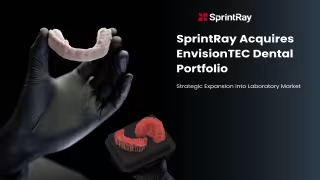
SprintRay’s EnvisionTEC Dental Acquisition Signals a New Phase in 3D Printing Consolidation

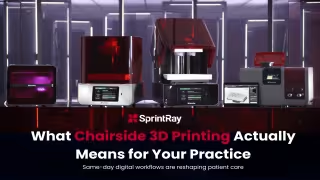
SHERIDAN, WYOMING - December 8, 2025 - SprintRay's acquisition of the EnvisionTEC dental product portfolio marks a strategic step in the consolidation of the dental 3D printing market, expanding its materials ecosystem, reinforcing supply resilience and giving both SprintRay and EnvisionTEC users clearer long-term pathways in digital production.

What Changes for SprintRay Customers: More Materials, Same Workflow

For existing SprintRay practices and labs, the immediate impact is about breadth rather than disruption. The EnvisionTEC dental portfolio brings additional validated resin formulations that SprintRay is adapting for its own printers, which means customers gain more material options without having to invest in new hardware.

How In-House 3D Printing Turns Your Dental Lab from Vendor into Strategic Partner

Submitted by fairsonline_team on
Image
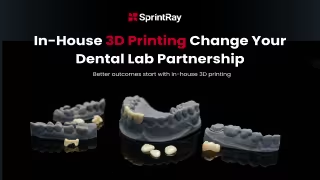
How In-House 3D Printing Turns Your Dental Lab from Vendor into Strategic Partner

SHERIDAN, WYOMING - December 8, 2025 - As more practices adopt chairside 3D printing, many clinicians worry quietly about what it means for long-standing dental lab relationships-but rather than replacing labs, in-house production is reshaping them into higher-value, more strategic partnerships built around clearly defined roles and shared digital workflows.

From Full Lab Dependency to Hybrid Production

For years, the dominant model in restorative and appliance production has been full lab dependency: every crown, bridge, model, surgical guide, night guard or retainer went out the door to a third-party provider. In that setup, "Lab controls your timeline. Lab controls your cost per case. Lab capacity limits your capacity. Emergency cases wait on lab availability."

How Chairside 3D Printing with SprintRay Rewrites the Economics of Restorative Dentistry

Submitted by fairsonline_team on
Image
How Chairside 3D Printing with SprintRay Rewrites the Economics of Restorative Dentistry

SHERIDAN, WYOMING - December 8, 2025 - Chairside 3D printing has moved from conference buzzword to everyday reality in U.S. dental practices, and SprintRay is positioning its ecosystem as a way for clinics to bring production in-house, compress treatment timelines, and turn same-day crowns into a strategic differentiator rather than a marketing slogan.

From Lab Dependency to In-Practice Production

At its core, "chairside" simply means producing the restoration in your own practice while the patient is still in your care, instead of sending cases to an external lab and waiting one to two weeks. Clinically, the workflow is familiar-examination, preparation, design and cementation remain the same-but the fabrication step moves from a third party you can't control to equipment in your operatory that you can.